

A new round of funding is now open to Long Island property owners willing to trade some lawn for native plants—and the reasons to apply go beyond a reimbursement check.
The Long Island Garden Rewards Program, a partnership among the Long Island Regional Planning Council, the New York State Department of Environmental Conservation, the Long Island Sound Partnership, the Long Island South Shore Estuary Reserve Program, and NEIWPCC, offers reimbursements of up to $500 to property owners who install rain barrels, create rain gardens, or plant native species on their land. Homeowners, businesses, and nonprofits are eligible. Applications are processed on a first-come, first-served basis until funding runs out. Since the program launched in 2023, more than 580 property owners have received reimbursements.
“Native plants are homes to our local wildlife,” said Robin Silvestri, executive director of Save the Great South Bay. “A Japanese maple is never going to be able to provide food for a local bird because they don’t recognize it.”
Her organization’s approach to addressing that problem begins with a simple principle. “Start where you stand,” Silvestri said. “Everybody can play a role in improving water quality. You don’t have to save the polar bears or fix the bay all on your own, but you can start in your own backyard.”
The program arrives at a moment when the case for native planting extends well beyond water quality. Urbanization and the spread of non-native plants have been linked to rising rates of seasonal allergies. Native plants evolved alongside local birds and insects that transfer pollen directly from plant to plant. Invasive species, by contrast, rely on wind to disperse their seeds, releasing large quantities of airborne pollen that trigger allergic rhinitis and asthma. Scientific studies indicate that urban environments often have higher allergenicity because invasive species occupy vacant ecological niches and extend the local flowering season.
Changes to the lawn have consequences for the bay
Native plants stabilize soil and filter nitrogen before it reaches the water, which is critical in South Shore communities where many homes rely on a cesspool. When rain falls on conventional lawns and hardscaped surfaces, it carries fertilizers, pesticides, and other pollutants directly into local waterways.
Silvestri points to fertilizer use as among the most damaging habits homeowners can change. “Reduce, if not eliminate, the use of fertilizers,” she said. “That’s like the biggest one.”
Rain gardens—landscaped depressions planted with deep-rooted native plants—intercept runoff and allow it to filter slowly into the ground. The Garden Rewards Program reimburses up to $500 for a rain garden of at least 20 square feet, provided the plants are on the program’s eligible native plant list. Rain barrels offer a simpler entry point, with reimbursements of up to $125 each for barrels of at least 50 gallons that are fitted with mosquito netting or screening.
Selecting the right native plants matters as much as planting them
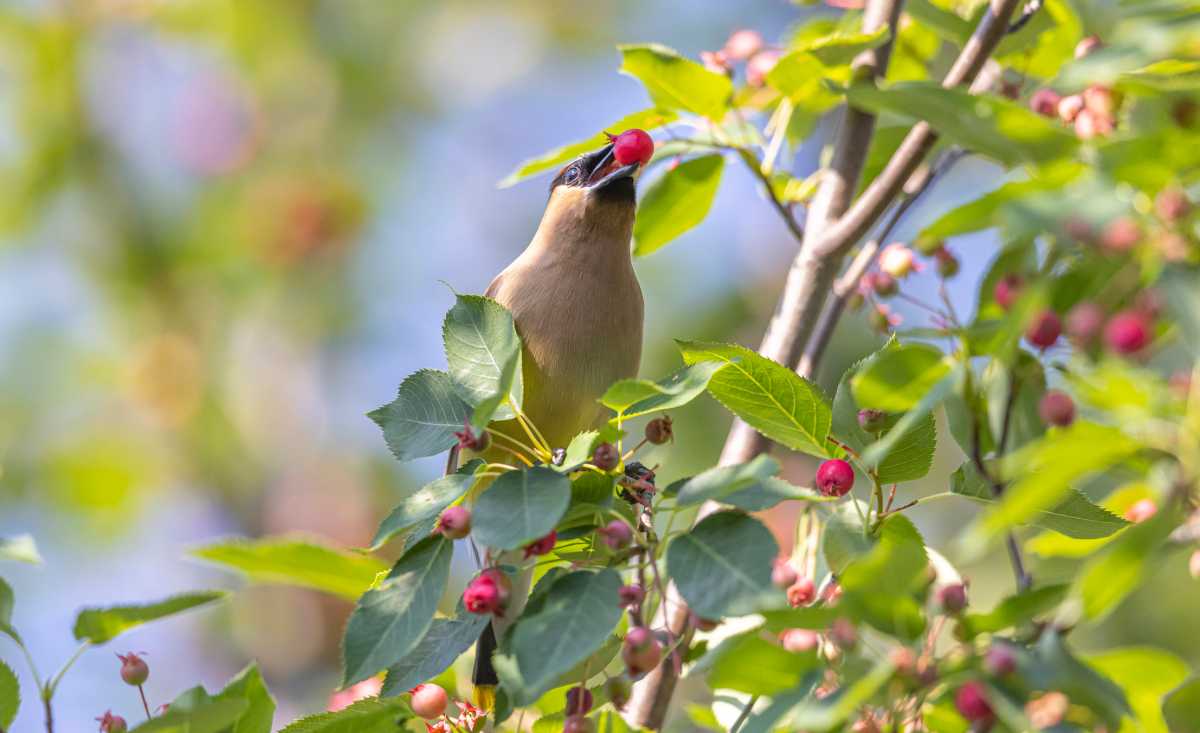
Mike Lovell, a volunteer “Creek Defender,” draws on his four decades in the landscaping business and on the research of University of Delaware entomologist Doug Tallamy, whose book Nature’s best Hope: A New Approach to Conservation That Starts in Your Yard, documents how native species sustain entire food chains that invasive plants cannot. “Oaks, cherries, and willows are the most beneficial plants for birds,” Lovell said. “They produce the most fruit and insects birds can eat.”
Save the Great South Bay recommends bayberry and beach plum for full sun, and silky dogwood or serviceberry for partially shaded areas. Lovell notes that planting beneficial species a few feet apart allows them to eventually shade the ground. “The invasives will stop coming back,” he said.
Maintenance habits matter as much as plant selection
Leaving leaf litter on the ground protects the vast majority of caterpillar species that pupate in the soil and among fallen leaves. Reducing outdoor security lighting helps nocturnal pollinators, whose reproductive cycles are disrupted by artificial light. Native habitat restoration, stormwater management, and eco-friendly maintenance: Silvestri said these habits create a bay-friendly yard.
“Lawns are the dominating situation,” Lovell echoed. But the scale of what’s needed goes beyond any single yard.
“It’s going to take an army to restore what has been lost on Long Island,” Silvestri said. Local governments, she notes, control roadsides and public spaces that dwarf what any homeowner can manage. “The county owns hundreds of thousands of acres,” she said. “They have the chance to have a much bigger impact with proper management.”
Community organizations are already modeling what collective action looks like. Adrienne Esposito, executive director of the Citizens Campaign for the Environment, was among volunteers in the Village of Patchogue in May who planted thousands of pollinator-attracting plants—drawing bees, dragonflies, and butterflies to a public space. The group is also installing another garden at North Corey Park in Blue Point.
The effort was funded by a grant from the New York State Attorney General’s 2023 settlement with Monsanto, which faced multi-billion-dollar litigation over claims that its glyphosate-based herbicide Roundup caused non-Hodgkin lymphoma in thousands of users. Esposito called the funding a “good use of the settlement money,” adding, “The village believes in getting their hands dirty to achieve a good goal.”
TJ Hatter, a representative from the Attorney General’s Office, said the hope is that “the volunteers and the entire village get to enjoy the fruits of this labor.”
Lovell sees that spirit spreading, slowly but visibly. He believes the direction is clear and that individual responsibility is the only reliable path to long-term recovery. “I can drive down the road, and you can see people trying,” he said. “No one else is going to do it.”
The Long Island Garden Rewards Program application is open now. More information, including the eligible native plant list, is available through the Long Island Regional Planning Council: lirpc.org/sustainable-landscaping-resource-hub/