

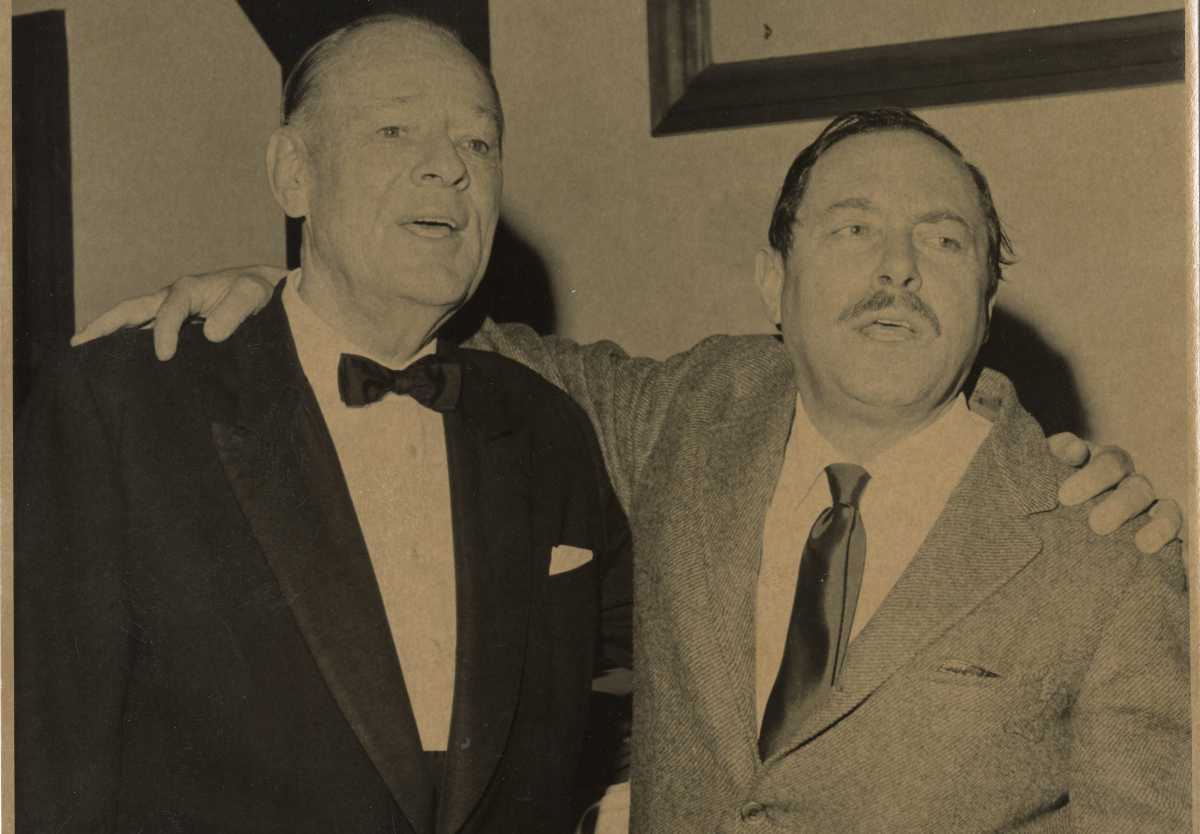
The year 2026 marks the 115th anniversary of Tennessee Williams‘ birth.
Known for his groundbreaking plays that combined symbolism, metaphor, and realism to create works such as The Glass Menagerie, A Streetcar Named Desire, Cat on a Hot Tin Roof, and Suddenly Last Summer, he left an undeniable mark on the craft.
However, Williams’s success can be summed up in his own words as, “If writing is honest, it cannot be separated from the man who wrote it.”
Much of the inspiration for his characters stemmed from his own background. He witnessed the relationship between his alcoholic father, submissive mother, and a sister struggling with mental health, while negotiating his own desires regarding his sexuality.
On the eve of the Lavender Scare, Williams and his partner Frank Merlo found sanctuary in the Fire Island Pines and Cherry Grove communities. Shielded from most biases stirred up by homophobic rhetoric, these communities were centered on discretion.
“Tennessee Williams, who was openly gay in the repressive eras of ‘closeted’ life, was an occasional guest in Cherry Grove,” Cherry Grove historian Carl Luss explained. “’T’ was Tennessee Williams’ private nickname among residents Natalia Danesi-Murray and Janet Flanner.”
Luss uncovered Williams’ time on Fire Island while conducting interviews for his application to list the historic Cherry Grove Community House and Theater on the National Register. His efforts prevailed in 2013.
Audrey Hartmann explained to Luss in one of these interviews that Williams was invited to a housewarming party in 1974, stating, “T was the first to arrive and the last to leave. Maggie (Maggie MacCorkle was Hartmann’s partner), being from the South, got along with him like a house on fire.”
Williams was known not only in Cherry Grove but also in the Pines for his circle of renowned artists and intellectual contemporaries.
“Writer Donald Windham, while summering in the Pines, formed a strong bond not only with Williams but also with Lincoln Kirstein, Gore Vidal, Truman Capote, and Frank Carrington (owner of Carrington Estates located between Cherry Grove and the Pines),” stated Bill Hildebrant, a historian for the Carrington house, now also on the national Register since 2014.
Windham and his partner, Sandy Campbell, who had the closest friendship with Williams, hosted him at their house in the Pines. Windham, like Williams, was born in the South, and some acquaintances of both claimed that Williams introduced Windham to the gay artist scene across New York City and coached him through his early writing years. Through the bonds of friendship cemented in the backdrop of Fire Island, Windham wrote Two People (1955), The Hero Continues (1960), inspired by Williams’ life, and Emblems of Conduct (1964).
But the collaborations between Williams and Windham began to fray with the play “You Touched Me.” According to Windham, the idea of adapting it as a play was his, yet when it was released, Williams removed Windham’s name from the publicity materials. The second and biggest fallout came from their collaboration on “The Starless Air.” According to Windham, he was barred from rehearsals, some lines were cut, and references to those lines were used in Williams’ smash hit “Cat on a Hot Tin Roof.”
By the mid-70s, Windham and Williams were estranged, prompting Windham to write a tell-all book titled Tennessee Williams’ Letters to Donald Windham: 1940-1965, which published their personal correspondence.
Upon the 1977 release, New York Times book reviewer Robert Brustein stated: “If revenge is a dish that tastes best cold, then Donald Windham has certainly fixed himself a satisfying frozen dinner.”
In these published letters, according to Brustein, Williams was a man “preoccupied with announcing his erotic adventures but only eclipsed by his hypochondriacal worries over his health.” Further details in the book were his inner disdain for Truman Capote.
In response to the release of Windham’s book and Brustein’s review, Williams wrote an editorial in the New York Times stating, “It may seem I am ashamed of the letters, which I am certainly not. Less biased reviewers have praised them for their vitality and life-enduring power of expression. I am not alone in regarding them as valuable documentation of a young writer’s way to survive the difficult climb to achievement.”
Williams died unexpectedly in New York City in 1983, which dealt the literary world a death blow. But the end of this literary dynasty on Fire Island came on a June morning in 1988. Campbell, while having breakfast with Windham in their Fire Island Pines home, died of a heart attack, ending all summer residencies on Fire Island.