

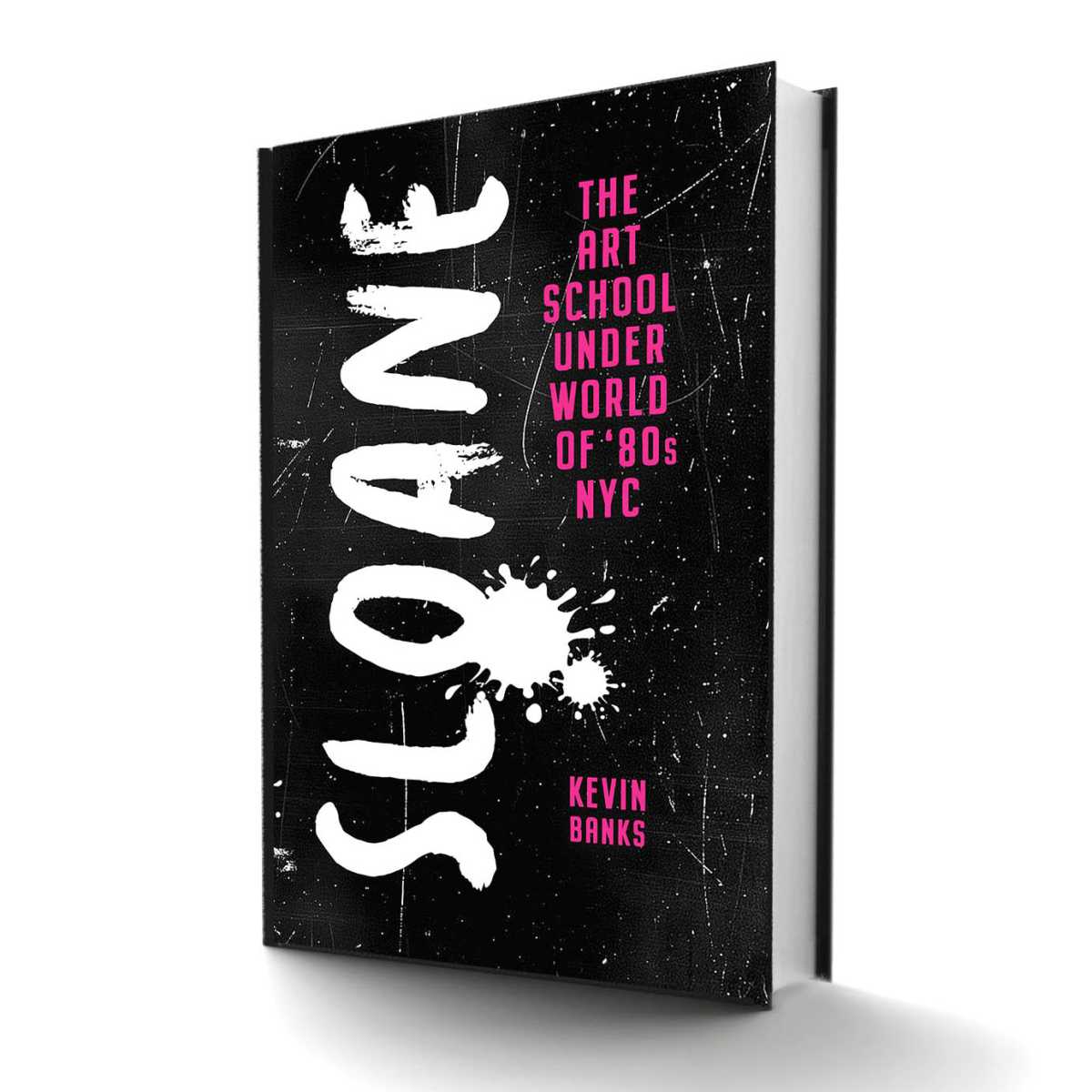
The lyrics of the classic Village People song ring true. It is fun to stay at the Y.M.C.A., especially if you’re an art student in New York City (NYC) during the ‘80s, which is the case for Evan, the protagonist in Sloane by Kevin Banks.
At the beginning of the novel, Banks describes Sloane as a work of fiction inspired by real events. It’s more than fitting, since he was a graduate of the School of Visual Arts and stayed at Sloane himself. However, Banks never really felt like he was a good writer, but he could better report on what he knew through his and his friends’ experiences.
When asked about the inspiration behind the novel (beyond the callbacks to his personal life), Banks broke it down into two parts: writing it and getting it published. He didn’t start putting pen to paper until after 2013, when he hosted Sloane reunions in Midtown Manhattan.
“On the Amtrak, on the way home, I would always think to myself, I should write down some of those stories before they’re forgotten,” Banks shared. Ultimately, it was his wife who encouraged him to turn those pages and stories into a book.
It’s those memories and feelings of a shared community that really made Sloane a compelling read. The building, located close to Penn Station on 34th Street at the time, housed art school students, elderly people, NYC locals, transients, and many others, and Banks made it feel like a character rather than just a setting. He specifically described it as a “buffet of personalities,” noting how special the experience was because, regardless of generation, “you can shut off your phone, but you can’t shut off New York City.”

Speaking of the city, the universality that Banks writes about stands the test of time, even if you’re just discovering those stories or the city as a whole. One passage near the end of the book especially captures that spirit: “New York in the ‘80s is a perfect storm of social whiplash and cultural combustion, a city still reeling from the anarchic hangover of the ‘70s, now doubling down on its own dysfunction.”
And that’s far from the only moment that feels strikingly relatable, even for readers who never set foot in NYC in the ‘80s. The way Banks describes certain institutions, such as Penn Station, Times Square, and other New York landmarks, could just as easily be about something witnessed yesterday, a decade ago, or 40 years earlier. Yes, New York City has transformed over the years, but its overall essence and the sense of community woven through it remain intact.
What Banks does so well throughout the book is give readers little glimpses into Sloane. The chapters are short, each feeling almost like an episode or snapshot without overstaying its welcome. The characters are clearly distinguished: Evan as the narrator, and Ryan and Jack as his two best friends, always along for the shenanigans. Plus, the timeline follows them from freshman year through graduation, though it isn’t fully realized until the end.
Some moments in the book felt darker, while others were less serious (think dorm life rather than class time). I really could picture what life at Sloane was like then. From the smells and sights to the sense of shared human experience, Banks effortlessly captured the unique qualities that make NYC so special.
Many Long Islanders who lived in the Sloane House dormitory while attending college in NYC, or NYC transplants who came from far-flung places and eventually settled on Long Island, will read this fictionalized memoir with fondness.
As a Jersey girl who has loved NYC since I was little, I felt this was a love letter to one of my favorite places, which, after speaking with Banks, was exactly one of his goals.