

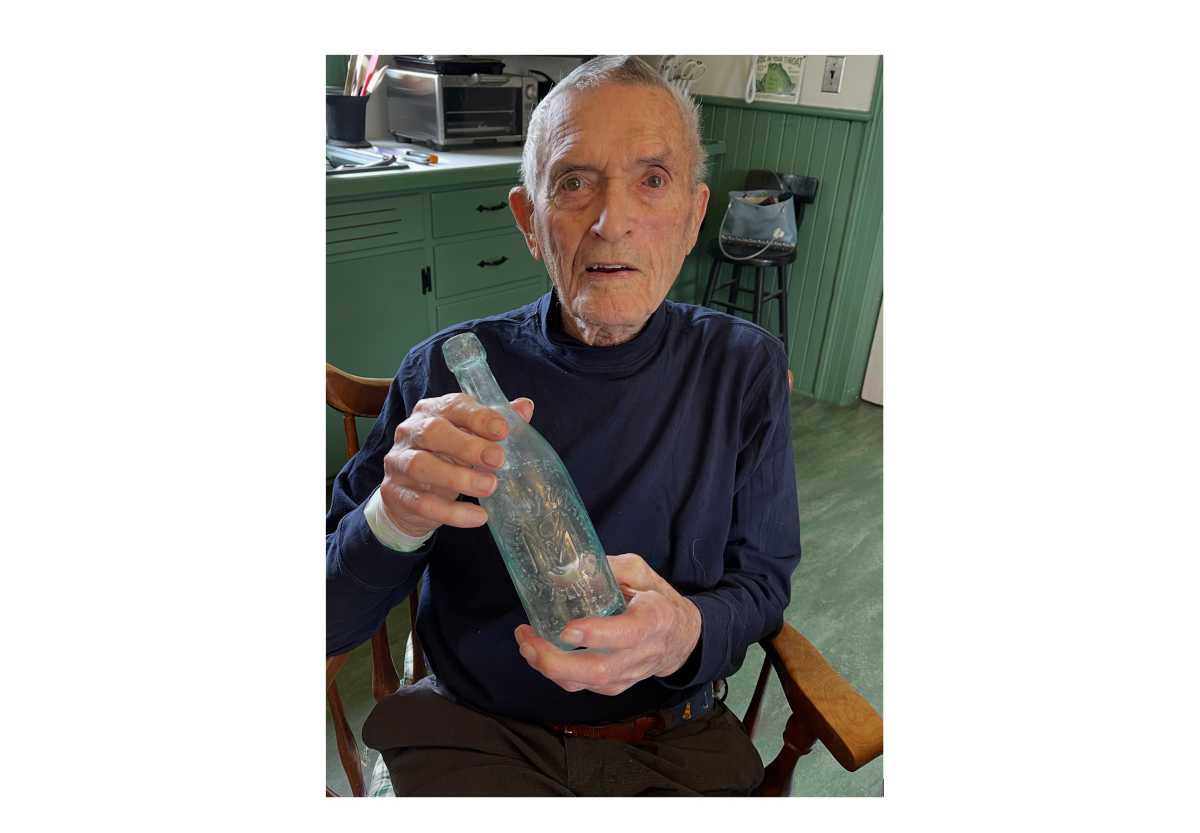
Preston Carter Raynor of Islip celebrated his 102nd birthday on May 29. He is one of the estimated 624 Long Islanders age 100 or older. The breakdown by region is 330 in Nassau County and 294 in Suffolk County. Each of these individuals carries an indispensable eyewitness account of an ever-changing society. During his 102 years, he has witnessed sleepy rural, forested Gilded Age estates of Islip transform into a thriving suburban hamlet.
The Fire Island News (FIN): Describe your family’s history with Islip.
Preston Raynor (PR): My grandparents [mother’s side, Markvart] were originally from the Czech Republic. They managed the East Islip Hotel [between the 1890s and 1900], and brewed beer for the Vanderbilt Idle Hour Estate. Becoming known for their beer-brewing, my grandfather quickly became acquainted with wealthy Gilded Age estate families, the Macy heirs of Islip, the Belmonts of East Islip, and Taylor, who had their estate located in present-day Heckscher State Park.
FIN: What was the local economy based on when you were growing up?
PR: When I was growing up, the local economy was tough; all we ate was corn, a lot of fish, chicken, and potatoes. During the Great Depression, my father’s contracting company had no business, and my mother had to take a job as a secretary with the Carlisle Estate [located in Islip, across from the current-day Brookwood Hall], the heirs to the Pinkerton Detective Agency. Many local baymen, if they had work, worked at the Doxsee canning company in Islip and on Fire Island. Doxsee owned Bay Berry Point and much of Islip. Freeport was another area where they [Doxsee] packed out fish for market. My grandfather built a house for Doxsee on Meadow Island in Zachs Bay, by the inlet, for his Freeport operation. They later moved the house on a scow to Point Lookout.
FIN: Do you recall any Prohibition or rum-running activity?
PR: Many baymen used to transport cases of liquor from the nets set up along the shoreline and hide them once ashore at Bayberry Point. Some of the Islip families earned enough to be considered rich.
FIN: Do you remember the Hurricane of 1938?
PR: Oh yeh. I was in school, and they let us out at 2 p.m. My friend and I left school for Bayberry Point to see what was going on and to check on our boats, which had capsized in the canals. The wind was blowing so hard we could barely stand up. The next day was gorgeous, and we sailed to Fair Harbor, where we saw much of the town reduced to stumps or poles sticking out of the sand, and the bay was filled with junk.”
FIN: What are your memories of World War II?
PR: I was in high school when Pearl Harbor was attacked, and the following June of 1942, I graduated. I enlisted in the Army Air Corps in 1943 and later transferred to the Transportation Corps. They sent me to Amherst College for meteorology, then to communications school, and I became a radio man aboard a troop transport ship bound for Europe. My closest high school friend, Gifford Doxsee, was captured at the Battle of the Bulge with that writer Kurt Vonnegut, who was also in the same squad.
FIN: After the war, how did Islip change?
PR: The area became all commuters; before the war, everyone was employed by local businesses. Another change was that the estates, like sugar magnate W. K. Dick’s of the National Sugar Refining Company [known as Allen Winden Farm; encompassing 200 acres on South Ocean Ave, to the west side of Bayberry Point], which had 21 employees, [was] … torn down and developed into houses. The surrounding areas of Bayberry Point, cheaply built McMansions, replaced the old corn fields and marshlands.
FIN: Many credit a combination of good genetics, low stress, and an active lifestyle to long life. What is your secret to longevity?
PR: Not smoking, not drinking except for an occasional cocktail, and a diet rich in fish.