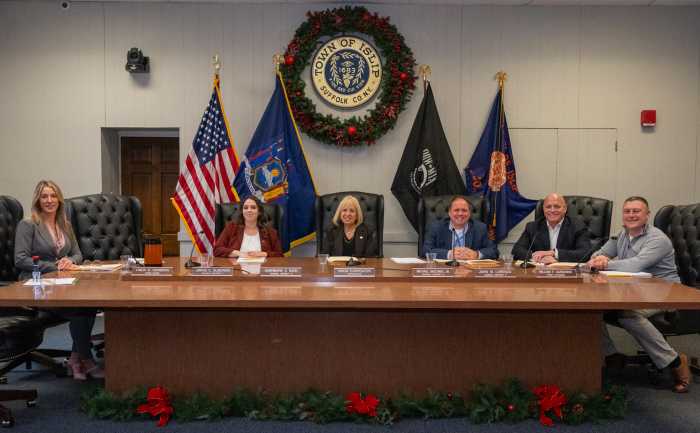


The Brookhaven Town Board adopted a $381.8 million spending plan for 2027 on Thursday, ending a marathon meeting during which residents urged officials to close the town landfill and treat a groundwater plume headed toward the Great South Bay.
Property taxes will fund nearly $199 million of the town’s operating expenses. The tax levy will remain below the state cap at 1.7%.
Departmental revenues and dedicated refuse fees cover the remainder, including landfill tipping fees—the largest single non-tax revenue line item—projected to generate $30 million from carters delivering incinerator ash, street sweepings, and auto scrap. The plan holds single-family refuse fees at $395.52.
The board also adopted a capital budget covering various projects through 2031.
Supervisor Dan Panico said the plan assumes no surplus and no property sales. “This is as clean a budget as you will find anywhere on Long Island,” he said.
Board members also cited the town’s top AAA and Aaa credit ratings from S&P Global Ratings and Moody’s.
Outside Town Hall, members of the Brookhaven Landfill Action and Remediation Group (BLARG) rallied for an immediate end to landfill operations in Yaphank. Organizers also said that closing the site means little if waste is simply hauled away by rail. Monique Fitzgerald, co-founder of BLARG, argued that “communities across the country have shown that reducing waste by 70% or more is possible through composting, reuse, repair, and smarter policies.”
During a public hearing, Lynne Maher of a Brookhaven hamlet criticized the town’s plan to install six additional monitoring wells to address a toxic plume of contamination emanating from the landfill, rather than a proposal to pump and treat the contaminated groundwater. The New York State Department of Environmental Conservation (DEC) rejected Brookhaven’s initial set of landfill corrective measures as inadequate. She said that monitoring allows leachate to continue flowing into Beaver Dam Creek and the bay without treatment. “I realize that pump and treat can be an expensive proposition, but I feel that it’s the only solution,” she said.
Panico responded that the state, not the town, bears most of the blame for the contamination. New York built the landfill’s early cells before transferring the site to Brookhaven.
“The identified issues associated that were just spoken about are predominantly and overwhelmingly from the cells built by New York State,”he said.
Panico further urged residents to press Albany to fund groundwater treatment through the $4.2 billion Environmental Bond Act, and he did not defend landfilling itself.
“Landfilling is a very primitive way of dealing with your waste,” he said, adding that the board would like to reach zero waste. “But the state must help site the facilities that turn waste into other products,” Panico added at the meeting.
The landfill is scheduled to close around August 2028. Construction debris once accounted for 60% of incoming waste, but the site now accepts incinerator ash and street sweepings. Tipping fee revenue fell from $50.2 million in 2024 to the budgeted $30 million in 2027. The budget adds $200,000 to the landfill’s post-closure reserve, bringing it to $30 million.
The town expects $6 million per year in host payments from the Sunrise Wind offshore project, according to Newsday, along with other capital projects and grant funding to help offset lost fees.
Reworld, formerly Covanta, which operates the incinerator and is the subject of a whistleblower toxic dumping case that concluded with the town settling for $1 million, plans to haul its ash to out-of-state landfills once Brookhaven’s closes.
Panico also highlighted a looming deadline: power purchase agreements at waste-to-energy plants—the incinerators—expire in Oct. 2027. He cited Long Island’s freight-rail shortage for hauling waste, driven by several failed or stalled bids to open transfer stations in Suffolk County. He said local leaders are organizing a bipartisan coalition of town supervisors to seek state funding and relief from unfunded initiatives.
Mary Ellen Pantaleo, of Center Moriches, said she was upset to learn that accepting out-of-town garbage had propped up the town budget. “Frankly, I would never have wanted my tax burden lessened while we were harming another neighborhood and its people,” she said.