

Have you ever looked out over the Robert Moses Bridge and wondered what lies below the surface of our waterways? Well, researchers at Stony Brook University in the Frisk-Shipley Laboratory can tell you using something called “acoustic telemetry.” The researchers have granted me access to their data from 2023 to 2025 for their equipment located off Ocean Beach and beneath the Robert Moses Bridge.
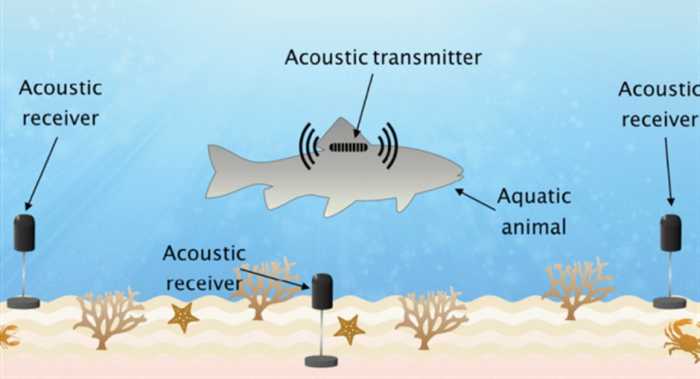
Acoustic telemetry uses sound waves to track tagged animals underwater. Animals are caught locally, and a tag is placed inside their body cavity through a quick surgery. These tags work like an EZ-PASS; the animal swims by the sensor (AKA a receiver), and the information is recorded internally. The receiver records an ID number unique to each individual, and some tags even record acceleration to estimate swimming speed and pressure to indicate the animal’s depth in the water column. Some of the tags used have a battery life of about 10 years. Every few months, this data is downloaded from the receiver and taken back to the lab for analysis.
The species list is long, consisting of Atlantic Sturgeon, Blacktip Shark, Bluefish, Clearnose Skate, Common Thresher Shark, Dusky Shark, Sandbar Shark, Sandtiger Shark, Smooth Dogfish, Smooth Hammerhead, Spinner Shark, Striped Bass, Summer Flounder, Winter Flounder, and Winter Skate. And those were just the tags for which they knew the identification numbers! The lab can also retrieve numbers from tags belonging to other researchers, and there is an online network where researchers can exchange such information.
Let’s dive into some highlights.
30 Atlantic Sturgeon known to the lab passed Fire Island between 2023 and 2025. Atlantic Sturgeon are protected under the Endangered Species Act in the New York Bight, as are Piping Plovers. Although the U.S. Geological Survey (USGS) reports that Atlantic Sturgeon have survived for 200 million years, their populations have declined due to overfishing and habitat loss. The term “Black Gold Rush” refers to the period between the late 1800s and early 1900s, when people came to the East Coast to hunt sturgeon for their eggs, which were used as caviar.
Two smooth hammerhead sharks have left the area and returned in 2024 and 2025. The shape of their heads (AKA the cephalofoil) allows them to see 360 degrees. Although Smooth Hammerhead Sharks are found worldwide, the Virginia Institute of Marine Science reports that their local habitat ranges from Nova Scotia to Florida, becoming less common at higher latitudes.
Striped Bass were detected by the receivers consistently in April, May, June, October, and November. This timeline coincides with the Striped Bass migration into and out of the Hudson River. Striped Bass are anadromous fish, which means they spend adulthood in saltwater but spawn in freshwater. How is this possible? They can regulate salt ions in their bodies to adapt to different environments during migration.
Unlikely but not extinct, small numbers of Winter Flounder were found in the data. What was once a thriving fishery in the 1960s is now harder to find in the Great South Bay. Only one of those fish was detected on two separate days, one in January and one in April. How exciting it is to see such a rare fish making a comeback to its ancestral grounds! Hopefully, this species will one day make a comeback in the Great South Bay.
Fire Island and the Great South Bay are not the only places that use acoustic telemetry. It is used all around the world. This allows scientists from different organizations to collaborate and track migrating species. The Frisk Laboratory itself has receivers from the Rockaways to Montauk, to the Peconic Bay, and to Long Island Sound.
Why should we care where the fish are?
“An essential question in fisheries management and fishing is, are the fish gone or are they somewhere else?” says PhD candidate in the Frisk Laboratory, Ashley Nicoll. “And this technology helps us address that.”
“It’s not just about the abundance,” Maria Manz, another PhD candidate in the lab, states. “The timing of fish migrations is important for sampling efforts and spatiotemporal management strategies. Continuous monitoring of fish movement is important in the face of climate change and our changing ocean ecosystem dynamics.”