

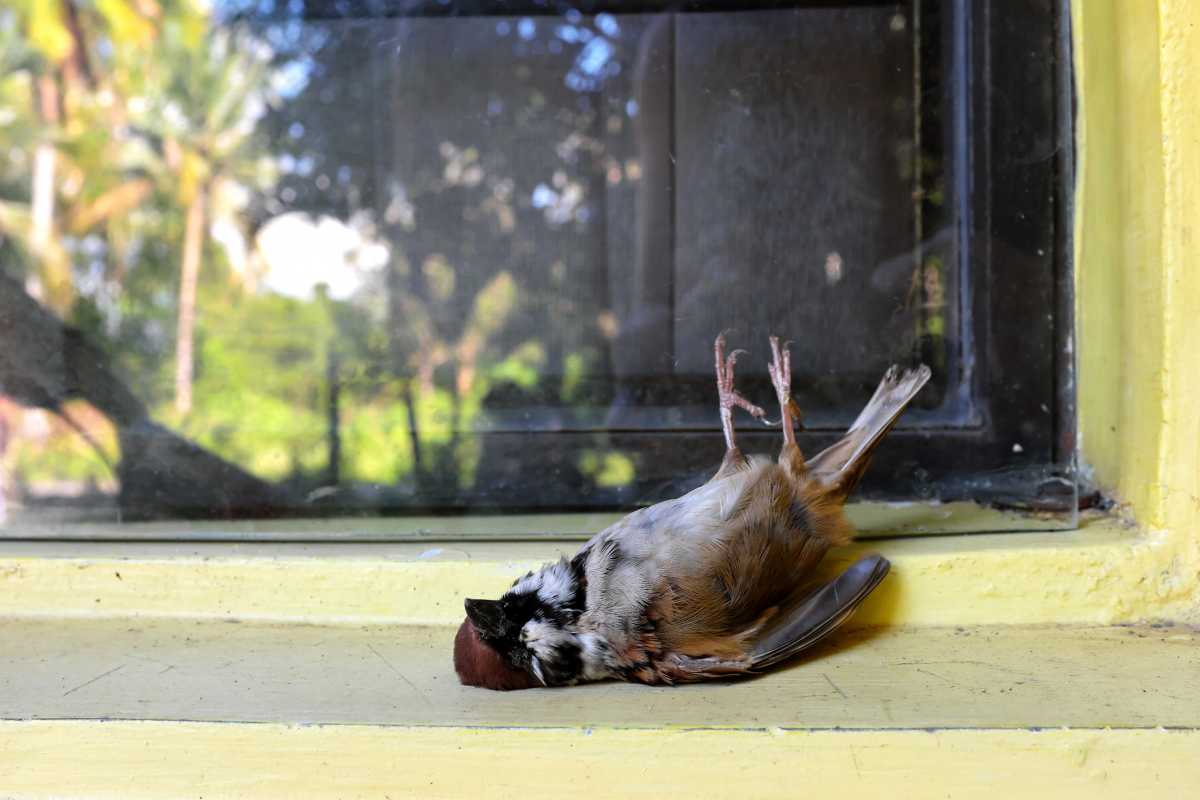
Every year, over one billion birds die from window collisions in the United States alone, according to the U.S. Fish and Wildlife Service. In a recent study completed by the American Bird Conservancy, Fordham University, and Stony Brook University, they found that just 40% of birds that collide with glass survive. So why is it so common for birds to fly into windows and glass?
“Birds don’t see glass; clean glass is virtually invisible,” explained Marc Kramer, the co-founder of Birding by Bus. “Birds don’t understand the concepts of windows and see the space where glass is as just another area they can pass through. Sometimes, windows on the outside reflect an image of the trees and sky that surround it—birds may see these reflections as more natural space and think they can fly through.”
Kramer, a Long Island native and Cornell University graduate, is a lifelong birder and veterinarian. He travels all over the world with his wife, Eliana Kramer—also the co-founder of Birding by Bus—as a guide and nature lover.
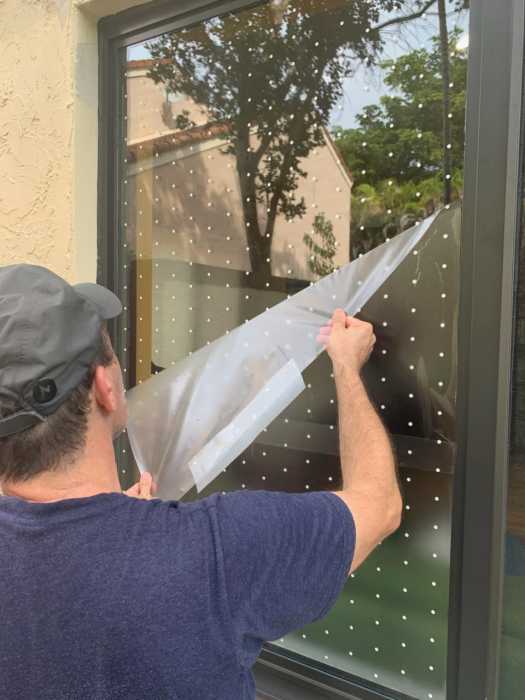
Fortunately, bird deterrent systems and technologies have been developed to help prevent these senseless avian fatalities. One of the most popular is Feather Friendly. Developed 18 years ago, this bird deterrent technology is a set of special markers applied to the outside of windows to break up the glass’s reflectiveness. This helps birds recognize that an object or barrier they can’t fly through is present.
“Personally, I feel Feather Friendly markers are currently the best available solution for preventing window strikes by birds,” stated Kramer. “Aesthetically, it’s the least noticeable to our eyes yet visible to the birds.”
In a case study conducted by Another Wild Goose Chase, Feather Friendly reduced bird strikes by over 95%.
“I think towns and cities should mandate bird-window collision deterrents for commercial buildings where bird losses due to window strikes can be high—it should become standard practice and enforced by local laws,” stated Kramer. With the proven success rate and the number of bird deaths increasing, the question of why deterrents aren’t mandated is definitely worth pondering.
According to Kramer, birds like warblers, thrushes, sparrows, and hummingbirds are the most common crashers. Gray catbirds, brown creepers, American goldfinches, yellow-bellied sapsuckers, hawks, and doves also frequently collide with glass windows.
“People don’t realize the extensive impacts of something like a bird-window crash that may not seem like it’s a big deal,” said Kramer. “With all these unnecessary bird deaths, our environment is slowly becoming quieter without the sounds of birdsong. Birds are essential environmental indicators, telling us about the health of our environment as a whole, while also playing pivotal roles in pest control, seed dispersal, pollination of plants, and food webs; when we lose them, it weakens the ecosystem’s health.”
The importance of birds in the environment really drives home the point that more is not being done to help, such as making deterrent systems mandatory.
While leading birding tours around the world, Kramer has seen several countries doing their part to help stop avian collisions. While in Bogotá, Colombia, at the National Botanical Garden Greenhouses (all glass buildings), he noticed they were covered entirely in bird-friendly window markers. In Costa Rica, Sky Adventures Arenal (a sky adventure park) was also doing its part to protect its windows.
“It was impressive to see they are trying to make a difference,” said Kramer.
Feather Friendly is not the only available deterrent system. Other options include Acopian bird savers, UV-treated glass, and anything that breaks up reflections from windows. Whatever the pick may be, it is clear that these deterrent systems should be much more popular than they are and, in some cases, even mandatory.
That said, in 2019, when Andrew Cuomo was the Governor of New York State, he vetoed bill S.25B/A.3410B, which aimed to establish a 15-member council within the New York State Department of Environmental Conservation (NYSDEC) to better study solutions for bird-building strikes. At the time, Cuomo cited associated costs as his reason for rejecting the bill.
That same year, New York City enacted Local Law 15, which mandates that new construction and major renovations use materials that reduce bird collisions in privately owned buildings within the city.
Currently, another state-level bill, the Feathered Lives Also Count Act (Senate Bill S7098A, also known as the FLACO Act), is advancing through the state legislature and would require bird-friendly designs for new or significantly altered state-owned buildings.
How will the governor respond when the bill reaches her desk?
Shoshanna McCollum contributed to this report.