

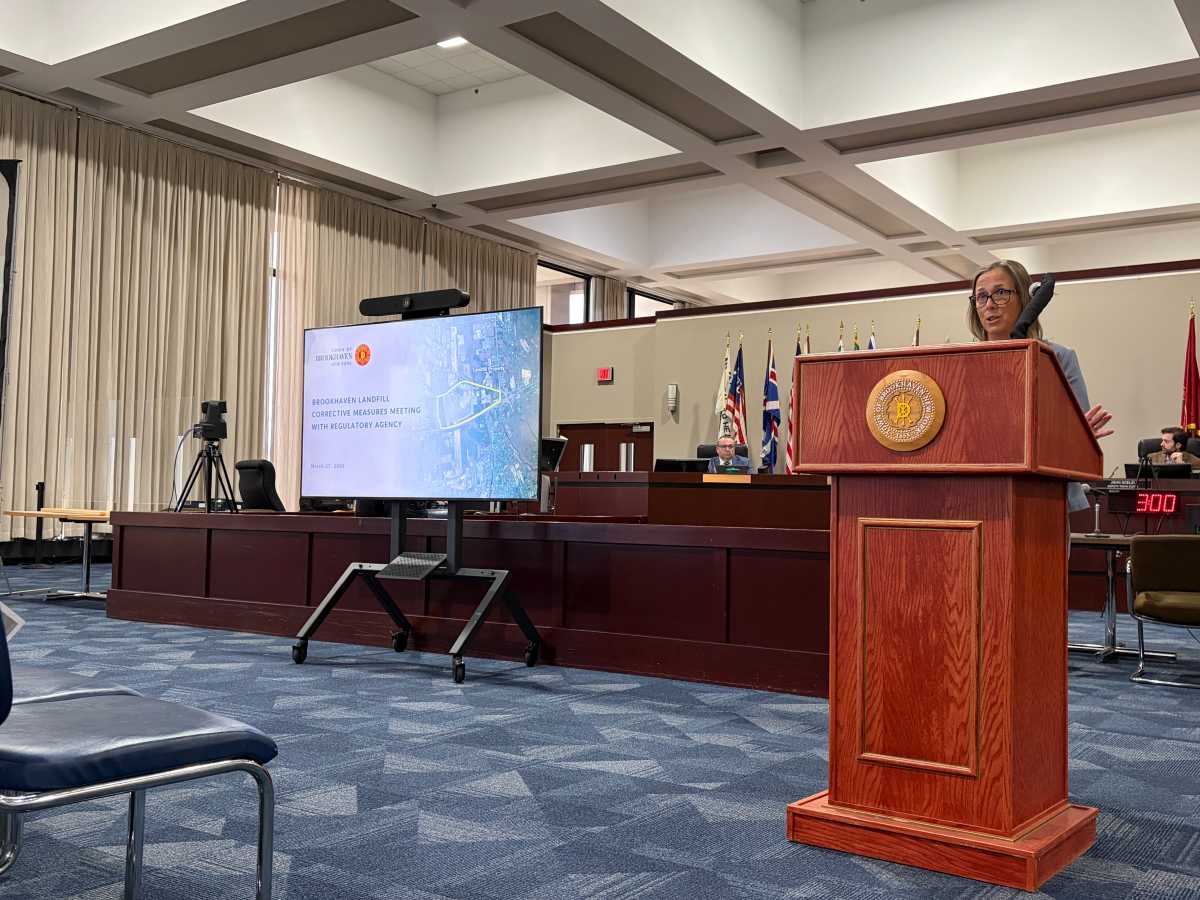
The Town of Brookhaven held a public meeting on March 27 to present its corrective measures plan for a toxic plume emanating from the town landfill in Yaphank, but community advocates say the proposal falls far short of what’s needed.
In 2023, the New York State Department of Environmental Conservation ordered the town to investigate and plan to remediate the plume, which now extends 1.7 miles from the portions of the landfill constructed between 1971 and 1989 south toward Bellport Bay. Groundwater testing detected PFAS (so-called “forever chemicals”) and 1,4-dioxane in the plume. Both contaminants have been linked to a range of health issues, including cancer.
The town’s recommended plan includes increased long-term monitoring with six new monitoring wells, connecting remaining private well properties to public water, and closing and capping the landfill by the end of 2029. According to the presentation, increased monitoring would cost the average homeowner $207 over 20 years, while connecting 14 residential properties to municipal water would cost $18 per homeowner and $267 per commercial property over 40 years.
Town consultants presented five alternatives for addressing the plume during the meeting at Brookhaven Town Hall but recommended against more aggressive cleanup options, citing cost and feasibility concerns. Groundwater extraction and treatment—pumping approximately 3.45 million gallons per day from six extraction wells and treating the water at an on-site facility—would cost $43,300 per homeowner over 40 years. Immediate landfill closure would cost homeowners $8,500 over 24 years. Landfill reclamation, physically removing 32 million cubic yards of waste, would cost homeowners nearly $3 million each over 75 years.
Christine Fetten, commissioner of Recycling and Sustainable Materials Management for the Town of Brookhaven, said the recommended plan includes closure but not immediate closure. “Closure once we fill that final phase to its permanent capacity,” she said. “If we do an immediate closure of that phase, that means we have to redesign the whole cap because you have a huge void in that phase that you’re going to have to make sure it’s stable and sheds the stormwater correctly.”
Monique Fitzgerald, co-founder of the Brookhaven Landfill Action and Remediation Group (BLARG), called the meeting—a session delayed since January at Brookhaven’s request to the state—a total waste of time. She noted that no elected officials attended, only town lawyers, the waste commissioner, state Department of Environmental Conservation support staff, and consultants who were reluctant to identify themselves or answer questions.
Fitzgerald criticized the town for suing the DEC over the cleanup mandate rather than pursuing Reworld, the waste-to-energy company formerly known as Covanta, which was investigated in a whistleblower case for allegedly dumping toxic ash at the facility. In the Covanta whistleblower case, the town said it had “no damages” and was not a victim of fraud despite the discovery of illegal dumping, and moved to settle, accepting a $1 million payment from Covanta to end the litigation, while the company denied all liability.
“This is the most backward thing I can think of. Why make us pay when they could have made Reworld pay?” Fitzgerald asked.
She disputed the adequacy of the monitoring plan, calling six additional monitors at the landfill’s edge “totally not sufficient.” Fitzgerald also noted that the Suffolk County Water Authority (SCWA) is already treating contaminated water that residents are paying for—a cost not acknowledged in the town’s presentation.
“No remediation plans, no closure plans, no representation, just a sham and a show,” she said.
BLARG co-founder Hannah Thomas, who lives in North Bellport, where multiple people have sued the town over the years for illnesses allegedly connected to the landfill, questioned the lack of detailed closure plans.
“After our landfill is closed, where is our waste going to go; who else is it going to kill?”
Adrienne Esposito, executive director of Citizens Campaign for the Environment (CCE), said it was “shocking and irresponsible that the town offered no options to clean up the plume.” She said the town presented “false options with highly inflated price tags to justify their current plan to allow the plume to continue discharging into Beaver Dam Creek and eventually drain into Bellport Bay.”
“It was manipulation, and a bad sales job,” she said.
The town’s 2024 investigation confirmed that a portion of the plume discharges into Beaver Dam Creek. Surface water samples showed leachate influence from the historic plume, though concentrations of emerging contaminants in the creek are below state surface water standards. Beaver Dam Creek and that portion of Bellport Bay are already designated as uncertified shellfish areas, meaning consumption of shellfish is restricted.
All residents and businesses within the defined historic leachate plume area are connected to public water from the SCWA, which pumps water from aquifers outside the plume area and regularly tests the water to meet regulatory standards. As of 2022, of the 14 properties south of the landfill on private wells, three have already had water treatment systems installed.
Robert M. Calica, acting as special counsel for Brookhaven, said the town argues in court proceedings that it is entitled to immunity under a 2025 state statute that expanded liability exemptions for municipalities operating landfills.
The statute updated the state’s Superfund program to expand liability exemption for municipalities, public corporations, and fire districts that own or operate landfills, specifically concerning contamination from PFAS chemicals. The legislation aims to alleviate the significant financial burden on local governments facing potential liability for expensive cleanup and remediation activities. However, the exemption does not apply if a municipality or public corporation has, through action or inaction, “intentionally, knowingly, recklessly, or through gross negligence” caused or contributed to the release of hazardous waste.
While the town is proceeding with the DEC-mandated corrective measures, it is doing so with a “legal reservation of rights,” Calica said, pending the court’s determination on the applicability of the municipal exemption.
The public comment period runs through April 7. Comments must be emailed to RSM-LFHistoricplume@brookhavenny.gov. The town must submit its final corrective measures report to the DEC by May 1 for review and potential approval of the plan.