

Last October, President Trump, like presidents before him, issued an executive proclamation declaring Oct. 11, 2025, General Pulaski Memorial Day.
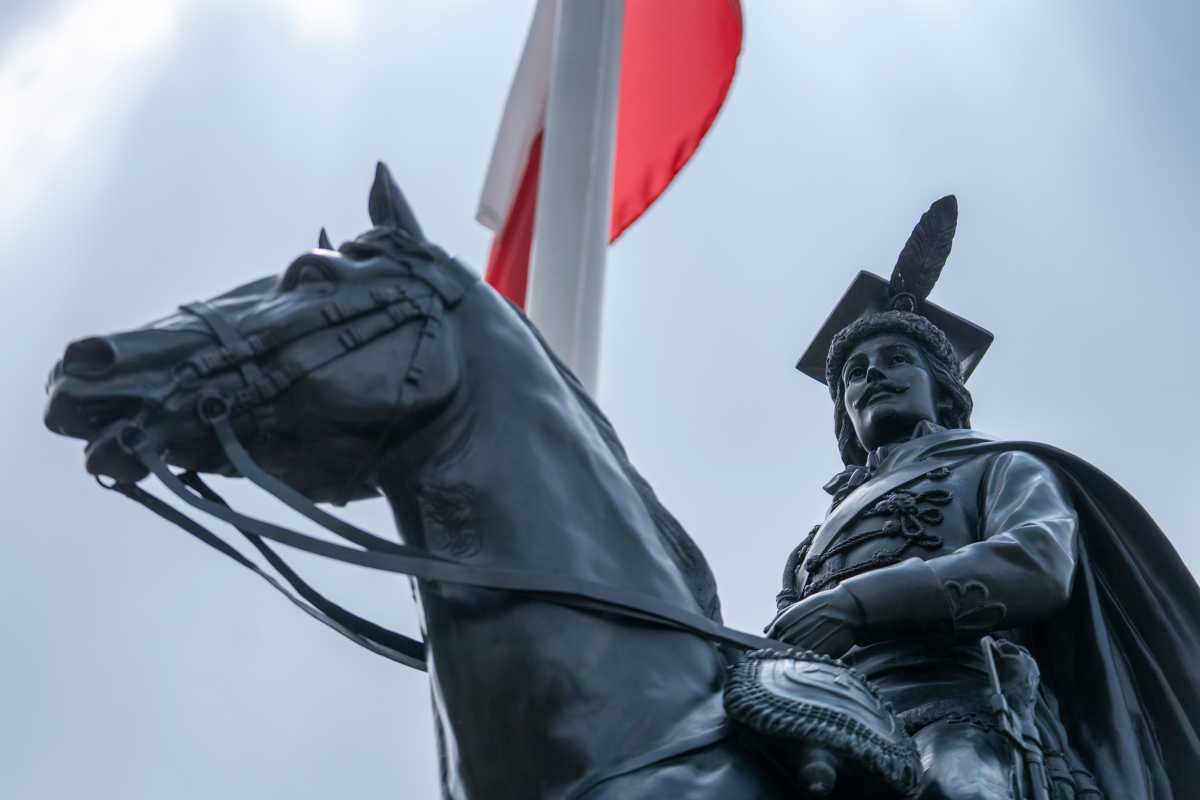
Pulaski, one of the most famous names across most Polish American communities in the tristate, is commemorated through the naming of Pulaski Road in Greenlawn, the Pulaski and Tadeusz Kosciuszko monument in Hempstead, and the Pulaski Skyway in Jersey City. However, his widely used name still prompts many historians to question who Kazimierz “Casimir” Pulaski was 246 years after his death.
Holding the distinction as Father of the American Cavalry, Pulaski’s role in the American Revolutionary War is legendary. After Franklin gained notoriety for his fight against the Russian conquest of the Polish-Lithuanian Commonwealth and was later exiled to France, he and Pulaski became acquainted. Following their friendship and shared ideals, Franklin asked him to join the Patriot cause of securing American Independence; Pulaski responded, “I will go to where freedom is being defended, to serve it, and to live or die for it.”
Before Pulaski’s arrival, the American Revolution was facing a major setback. Following the Battle of Long Island on Aug. 27, 1776, New York was lost to the British, and Washington’s army was facing low morale. Despite the challenges, in 1777, Pulaski enlisted in the Continental Army and fought with distinction at the Battle of Brandywine Creek, where he saved George Washington’s life. The British victory forced the evacuation of Patriots from Philadelphia but showcased the battlefield tenacity of Pulaski, who rose through the ranks to Brigadier General.
In his final battle, the Siege of Savannah, Pulaski took command of a French detachment and was hit by a grape shot. Within days of being shot, Pulaski died on Oct. 11, 1779, and became one of the war’s martyrs for freedom.
However, his story does not end with his heroic endeavors in the Revolutionary War.
Upon his death, the burial site of Pulaski has been surrounded by rumors and uncertainty about where he was laid to rest. Some accounts claimed he was buried at sea, while others argued he was buried on a plantation near Savannah that was serving as a field hospital.
To affirm his grave was in Savannah, researchers exhumed a body at the plantation that was believed to be Pulaski. The skeletal remains were estimated to be 5-foot-1 to 5-foot-4, had injuries to the right hand, and were aged 34 at the time of death (same height, documented war wounds, and age of Pulaski), but researchers had more questions than answers.
In a 2019 New York Times interview discussing the findings, Hutton Estabrook, of Georgia Southern University, stated, “The skeleton looked very female. The pelvic bones, a primary way of distinguishing sex in skeletons, indicated that the person had probably been a woman, and the body had other female characteristics, including a delicate face and rounded jaw line.”
Despite the features, a 2005 DNA test matched with another exhumed body in Poland, a descendant, confirming that the remains were Pulaski.
Combined with the features of the remains and the DNA match, researchers have concluded that Pulaski was most likely intersex.
On average, one in 2000 people are intersex, according to the Intersex Society of North America.
Intersex is defined as a “variety of conditions in which a person is born with a reproductive or sexual anatomy that doesn’t seem to fit the typical definitions of female or male.”
Portraits of Pulaski painted in his lifetime depict an attractive man with a receding hairline, and a well-defined mustache, but delicate facial features. General Pulaski never married. Was he keeping a secret, or did he not even know?
In an effort to officially answer the question as to whether Pulaski was intersex, Lisa Powell and Megan Moore of Eastern Michigan University conducted a mitochondrial DNA test on the remains. They compared it to other DNA samples from his descendants. The results, which were highlighted in the 2019 Smithsonian documentary The General Was Female? affirmed that he had an intersex condition.
The study had its critics, and historians in support of the belief that Pulaski was buried at sea claimed the exhumed remains in Savanna were not his. Others have seen the study as so-called woke. But how we celebrate Pulaski can be summed up in last October’s presidential proclamation, which stated: “I encourage all Americans to commemorate on this occasion those who have contributed to the furthering of our Nation.”