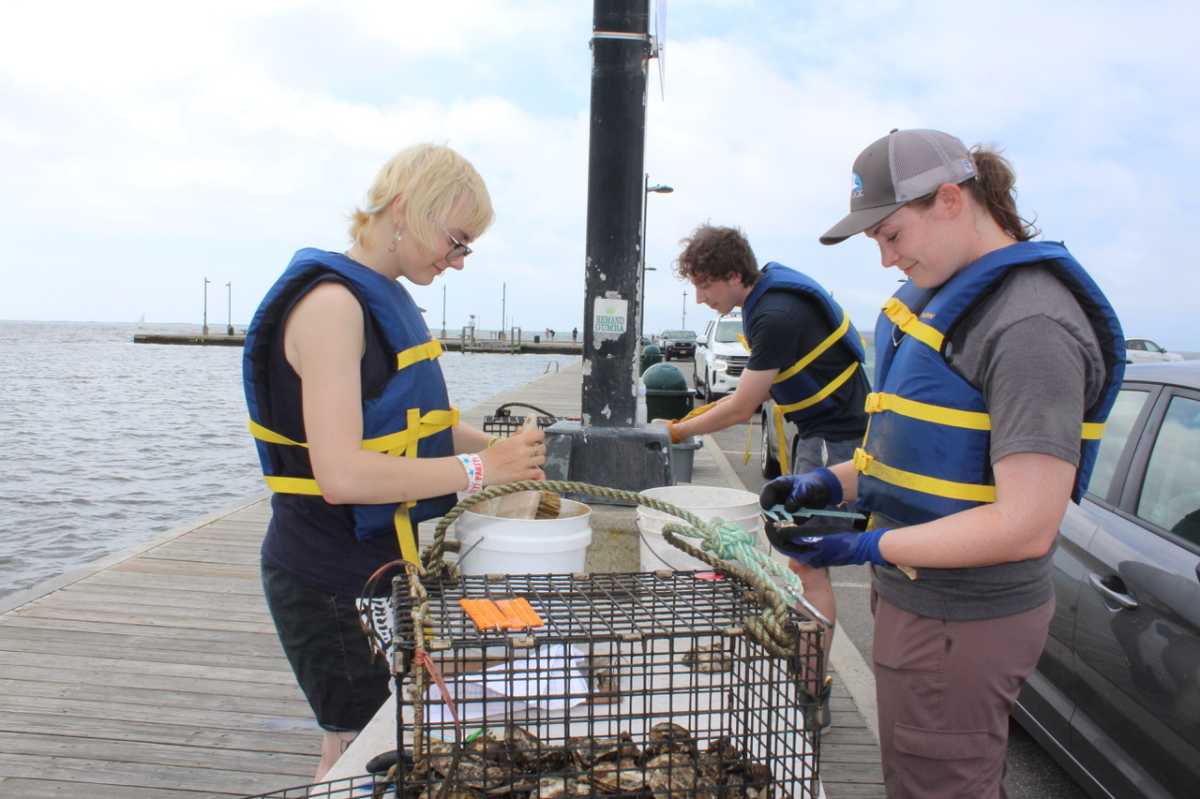
Seatuck Environmental Association educator Taylor Larson, along with colleagues Sacha Koulakova and Liam Denison, was gently scrubbing biofouling off spat, or baby oysters, growing on discarded shells on a table at Patchogue’s Mascot Dock. A light breeze rippled the water as walkers strolled by, some asking questions. Koulakova explained their process to a woman who had stopped.
The spat were taken out of their cage, used as a quasi-reef, and the gentle scrubbing is to keep the biofoul, an accumulation of microorganisms, under control.
They stood near the steps leading to a floating dock, which allowed them to lift the cages down from its side and bring them up for cleaning, then back down again.
Larson explained that a dock building company in Patchogue pre-assembled the structure.
“They ferried it over and installed the pilings. It was a cool process to witness,” she said.
Initiated in July, this program, which includes students studying and caring for oysters with Seatuck for three years, complements several non-profit groups’ ongoing oyster restoration efforts on the South Shore.
“The goal is to keep them alive for the school district’s students to study them this fall,” explained Larson of the collaboration with Patchogue-Medford. “We’re doing a year-long curriculum for elementary and middle schoolers with hands-on experiences. Each class will take care of them, measure their growth, and clean cages.”
Larson and the Introducing Students to Long Island’s Estuaries (ISLE) Fellowship students will be working on Mascot Dock until the end of October.
“Oysters go dormant in the winter, so the first year doing it will be different than next year’s in the sense that students will inherit oysters taken care of during the summer. In the spring, our permit requires them to be put on a reef or to partner with someone for their care. But then a new set will be cleaned by the class from the beginning and will be grown for next year’s class.”
“Right now, we have 18 in the water,” Larson said. “We’ll be getting a second batch of spat soon from the Town of Islip hatchery. They sit the spat on shells from our Half Shells for Habitat Oyster Shell Recovery Partnership, and we will have 35 cages altogether.”
Each shell has about 60 of the spat babies attached.
Seatuck Environmental Association, with a host of partners in 2018, initiated the island-wide Half Shells program to recover oyster shells from restaurants for use in oyster and habitat restoration efforts. Catch Oyster Bar is a nearby participant in Patchogue; others can be found in neighborhoods along the South Shore.
“We’ve been here about a month,” added Larson. “We come three days a week, and we want to use the program for students as a narrator for the history of the bay and how their choices may affect it.”
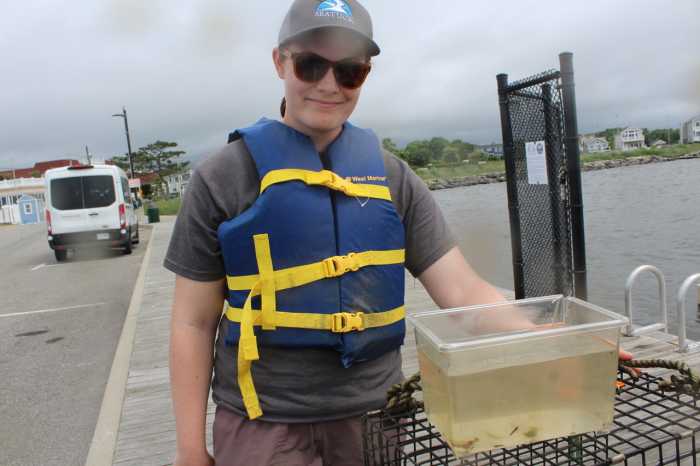
“This is really good for oysters,” said Koulakova, using a small kitchen scrub brush as she held a shell with spat. “I check for mortality, like how many have died during the week,” Larson said, explaining other aspects of their work. “We also clean the cages and track their growth. I’m curious to see how many are growing and we also do a biodiversity study. With the cages, we’re creating artificial reefs, so we’ll keep track of other animals. This morning, we brought up grass shrimp and juvenile blue crabs.”
“Sometimes a big one,” added Denison.
Koulakova, who has just graduated from Stony Brook University with a degree in marine science, and Denison, who is studying earth and oceanographic science at Bowdoin University, are ISLE Project Fellowship recipients, a new Seatuck program for college students that enables hands-on experience in conservation and education.
“We’ve been interacting a lot with visitors here, and a lot are even getting involved,” Larson said looking around at the dock as people passed peering over.
Patchogue Village had to give the green light for Seatuck’s presence; Mayor Paul Pontieri is enthusiastic about the program. “No one talked to us about oysters until Shorefront Park’s Living Shoreline was rebuilt,” he said of the project completed a couple of years ago.
A single oyster can filter and clean up to 50 gallons of water a day, and it’s a big bay. Every oyster counts.