Who knows what neglected cemetery souls cry out for recognition for? Whatever urgings took place, Hans Henke heard them at Patchogue’s Lakeview Cemetery. Back in 1991, while still working as a mechanic at his business, Henke Repair Service in Blue Point, Henke found that many of the markers or gravesites—including those of prominent families and the oldest founding merchants—were not identifiable. They were obscured by weeds and thick vines, making walking through the cemetery a challenge.
“You couldn’t walk three feet in any direction there because of the overgrowth,” said Greater Patchogue Historical Society treasurer Steve Lucas. “Hans was definitely the early mover, shaker, and later on, Steve Gill continued with it. Between the two of them, they were the ones who took it upon themselves to do something.”
Henke passed away at 96 on January 7. If there was ever a well-lived life, Henke’s journey is an inspiring example.
Henke began his cemetery tending on weekends in the early 1990s, then retired from his full-time job in 1997.
One formidable task was managing the 6-acre parcel, which wraps around from West Main Street to Waverly Avenue and includes a stretch of Lake Street. A combination of several co-joined Christian burial grounds—including Old Episcopal, Union, Gerard, and Rice— evolved from property on the corner of Waverly Avenue and West Main Street, purchased in 1791 for a church building.
Union Cemetery is the oldest, with its Revolutionary War, Civil War, and War of 1812 veterans.
Daughter Susan Henke-Brinkman recalled where her father started, to the east by the prominent Four Sisters Monument. Erected in 1909 by Patchogue resident Ruth Newey Smith as a memorial to her father, brother, and three sisters—Charlotte, Augusta, and Betsy Ann (the women were very philanthropic)—it was a mess back then, but the memorial is now striking. He also started to the west by Rice Cemetery.
Notables interred include over 100 veterans from several wars, as well as a slave child indentured to the Roe family and Elizabeth Oakes Smith, a women’s rights lecturer, author, and poet. Also interred are sailors who died tragically off Fire Island, where the Sailors’ Monument is located. There are an estimated 1,200 graves altogether.
Cleaning up those areas initially required a hatchet and a machete to clear vines and roots. Henke also found a homeless encampment on the grounds and tried to help.
“We were with the Patchogue Historical Society then and realized we had to be a separate entity to get grants,” Henke-Brinkman said. “So, we started the Cemetery Restoration Committee.”
Senator Caesar Trunzo then provided a grant for a ride-on mower.
“My dad had to make a path for the ride-on mower. He went through and catalogued every single stone,” Henke-Brinkman said.
By 2000, Henke was the sole steward maintaining the cemetery; his grandson, Paul, was an enthusiastic helper, and volunteers began showing up. Along with Gill, Christopher Capobianco and Paula Murphy were among the stalwarts.
In 2006, Gill took over stewardship of the chamber’s Greater Patchogue Foundation, raising funds for the distinctive Lakeview Cemetery gates and archway, as well as for lighting that floods the grounds at night.
Cemetery landscaping is now maintained by the Town of Brookhaven.
Fundraisers—such as the joyous Día de los Muertos gala in 2016, which featured a mariachi band, fortune readers, and cemetery tours under the stars in an elaborate tent at the Patchogue YMCA parking lot next to the cemetery—drew more attention.
But beyond tackling the cemetery, Henke’s devotion to Patchogue ephemera is that of a genealogist’s zeal.
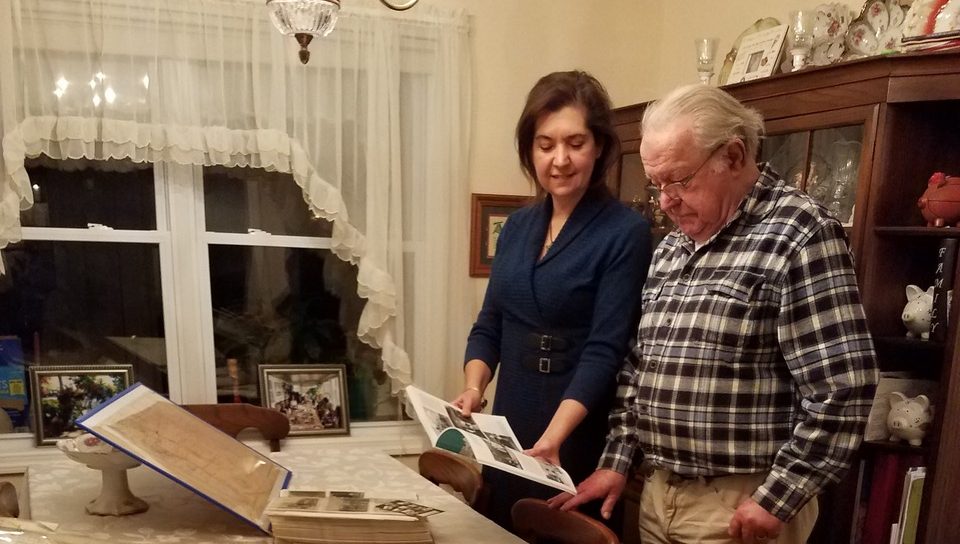
Henke-Brinkman said people always stopped by, wanting to sit with her father and talk about a piece of Patchogue history.
His basement on North Prospect Avenue is filled with numbered binders and file drawers of Patchogue’s past, including photos and postcards.
Starting in 1997, he wrote two books, Patchogue, New York: 1 and Volume II; when the publisher’s specifications proved too confining, Henke self-published two more.
His books were given to developers by Mayor Paul Pontieri.
“I started that when Tritec was doing the Four Corners,” Pontieri said.
“Tritec’s tower on the corner now resembles the clock tower of the former Swezey’s Department Store when it was a dominating building in the village.”
Henke and Gill were honored for their cemetery work in 2019 by the Greater Patchogue Chamber of Commerce and Patchogue Village, and in 2022, Henke was inducted into the Greater Patchogue Historical Society’s Hall of Fame, celebrating its 40th anniversary.
His wife, June (who died in 2022), was the love of his life, and so was his family. Henke’s back garden room overlooks his yard filled with statues and bird feeders, as well as the path to Henke-Brinkman’s back door.
“He loved to look at nature,” Henke-Brinkman said, “and he took in strays—mice, possums, whatever creature needed him, he took care of and released them back into the wild.
“He was never happier than when he was sitting at the dining room table surrounded by his family,” Henke-Brinkman said. That would be daughters Susan and her husband, Paul Brinkman, and Karen and her husband, Michael Johnson. Grandchildren Paul Hans, Victoria, and Olivia Brinkman, and Julia, Meaghan, and Michael Johnson.