

Blue Point and the rest of Suffolk County, following the devastating defeat of Washington’s forces at the Battle of Long Island in late August 1776, were in the grips of a British occupation. British shoreline fortifications stretched from Fort Greene, Brooklyn, to Sag Harbor, working around the clock—shipping all local resources stripped from South Shore communities to British command centers in New York City.
The Continental Congress, facing the dilemmas of the Patriot militias stretched thin and unable to build a strong navy, needed a strategic solution to the hemorrhaging of colonial resources—the answer: professional pirates.
During the Revolution, a total of 1,700 Letters of Marque were granted to professionalize privateers, who successfully captured 600 British ships along the East Coast. In New England and New York, Letters of Marque were issued by one of three individuals: the President of the Continental Congress, John Hancock; the Governor of Connecticut, Jonathan Trumbull; or the Governor of New York, George Clinton.
One overlooked shipping port, where multiple privateers practiced their craft and captured a handful of British ships, was Blue Point.
“While the land battles got most of the attention, there was significant action in the Great South Bay. The British would ship timber, or whatever they could pilfer, to send to their New York City headquarters. Blue Point is directly across from the current-day Point O’ Woods, which used to be the Fire Island inlet before it filled in. The British shipped their goods through the inlet at night, using the light from the beacons [signal fires that guided ships from running aground] to enter the shipping lane [west toward the city],” stated Warren McDowell, author of Blue Point Through the War Years, in an interview with Great South Bay News.
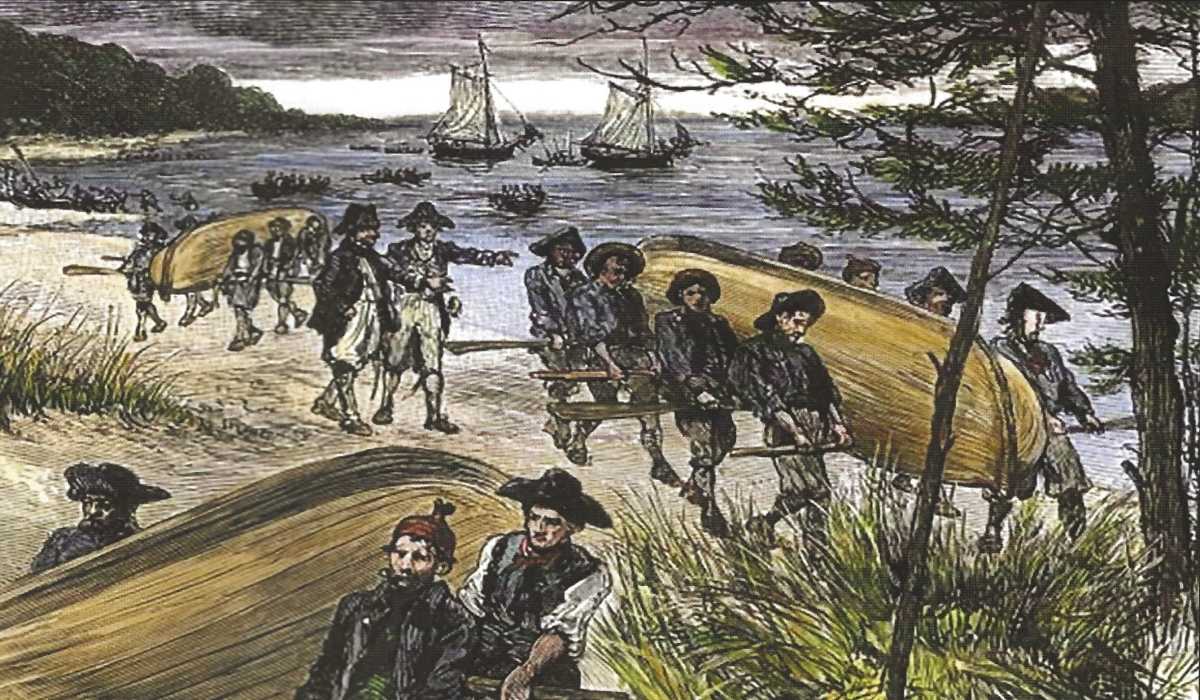
“Most of the Blue Point privateers were from the Hamptons or Connecticut, who utilized either whale boats with cannons mounted on each end, or periaugers (a shallow-draft, flat-bottom boat) equipped with a swivel gun. A successful raid paid privateers 50% of whatever they took, including seized ships, which were sailed to New London and put on auction,” explained McDowell.
Two successful privateers who attacked British ships in the cover of darkness, before they reached the light of the beacons, were Captain Ebenezer Dayton and Israel Deming.
Dayton was born in Coram on March 17, 1744, and made a living as a merchant/peddler. During the war, he enlisted in the Suffolk County militia and, after the Battle of Long Island, became one of many residents who fled to Connecticut. In 1778, Dayton received his Letter of Marque from Trumbull, and, with his armed schooner, Suffolk, he began nightly patrols in the Great South Bay near Blue Point, searching for British supply ships.
According to British dispatches from Long Island to New York City headquarters, between May 20, 1778, and December 5, 1778, Dayton commanded as many as 45 men in multiple whale boats and had an additional sloop named the Ranger, equipped with an arsenal of six carriage guns, swivel cannons, blunderbusses, muskets, and hand grenades. The largest skirmish between Dayton’s crew and Hessian soldiers occurred on November 30, 1778, resulting in multiple crew members being injured and retreating to the Moriches.
Despite resistance from Hessian soldiers, Dayton seized the British sloops Dispatch, Polly, Jane, and a periauger named Lively. The cargo included food and British army supplies, which were sold in various Connecticut markets.
Israel Deming, of Wethersfield, Connecticut, received his Letter of Marque on September 1, 1779, likely issued by Jonathan Trumbull. On October 1, 1779, commanding 40 sailors, Deming’s eight-gun sloop Washington captured two British transport sloops on the south side of the bay in Blue Point.
Adding to the attacks against the British, three days later, Privateer Captain Thomas King and his 70-person crew aboard the 12-gun brig Defiance, captured the British transport ship Badger off the coast of Blue Point, killing four Hessian soldiers and 21 British soldiers. Before the Badger was retaken by the British the next day, King seized all the small arms aboard the ship before retreating.
By 1780, new Letters of Marque were scaled back following France’s entry into the war. The last documented British vessel captured along the South Shore was at Fire Island Inlet on March 2, 1783. The British supply ship Peggy was seized by privateer Thomas Wickham.
In many cases, the real story of the South Shore privateer is overshadowed by legend.
“It took me 10 years to research this [privateer history]; however, one of the hardest things about this history is the parroting effect; it may not be accurate, but they will parrot it. If it is not documented, it is a story,” explained McDowell.