The Bayport Water Rescue Team has a tall order: Long Island’s South Shore has an estimated 118 miles of shoreline extending east to west. Along this vast stretch of shoreline, there are 1,400 square miles of landmass encompassing hundreds of canals in coastal towns, giving the area a distinctive feel—like Venice—which has defined life on the South Shore. However, as much as we adore our canals and shorelines, they pose a constant threat that requires an elite team of specialized emergency workers to brave the depths to save lives.
“We are a sub-division of the emergency services, like the SWAT team is to the police department,” explained Bayport Water Rescue Team Captain Jason Feinberg during an interview with Great South Bay News (GSBN) when asked about the department’s dive team. “Our water rescue division specializes in ice rescues, surface water rescues, and dive rescues or recoveries. The Bayport dive team is one of 10 teams on Long Island. Our team consists of 8 to 10 divers who work with other local fire departments, EMS units, and Suffolk County Police, as far north as Lake Ronkonkoma. We blend all our disciplines with rapid response because sometimes what starts as a surface-water rescue can transition into a dive recovery. We get an average of 20 to 34 water-rescue calls a year, which keep our dive team on standby.”
Unlike leisure-destination dives, the Great South Bay and many nearby waterways contain contaminants that lead to dense algal blooms, blocking light and creating dead zones where life cannot thrive, along with high levels of dangerous bacteria. This bacterial exposure, combined with the risk of becoming tangled in debris, can be deadly for inexperienced divers.
“The rescue dives are like diving with your eyes closed. This isn’t a tropical island dive,” Feinberg continued. “All divers wear a full encapsulated suit and mask to keep the bad stuff out. The bay’s visibility is one to two feet; however, black water in the canals—created by pollution from cesspool overflows, oil, and gas—renders visibility nonexistent. The depths of canals are eight to 12 feet, but four feet of murky silt, and you have to get below that silt because whatever goes into the water goes into that silt.”
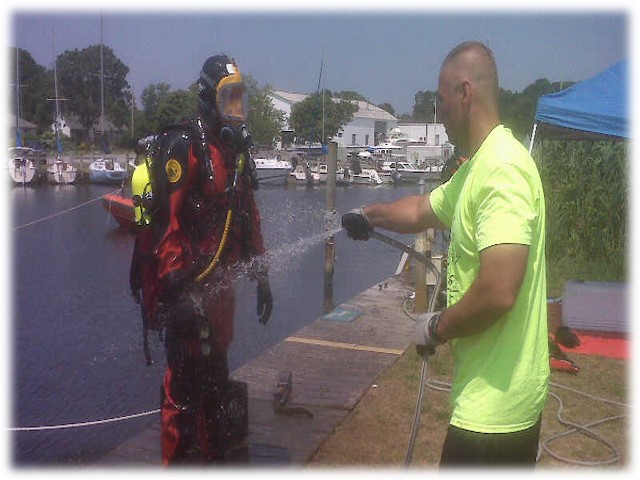
One of the training exercises led by dive instructor Lieutenant Barry Lipsky involves throwing a set of keys into black water (a canal), and the diver has 20 minutes to find them by feeling around the bottom.
“We host the largest ice rescue training class in the North East and the most extensive training for black water diving,” explained instructor Lipsky in an interview with GSBN. “If you can find something as small as car keys, you can find a body. In my class, we did 90 dives, and the entire class found all the small objects. We don’t train with dummies, just small objects.”
The other part of the training is for the people on land holding the lines. The team on land navigates the diver through line signals, and the communication devices in the diver’s helmet are used primarily for the diver’s immediate safety needs.
“In a real-life scenario, we time an hour before it becomes a recovery. The colder the water, the victim’s age determines whether a rescue or recovery will occur. But the dive time is always 20 minutes before they rotate, due to stress—you are looking for something not nice. This is not recreational diving,” Lipsky stated.
Based on the Bayport Water Rescue Team’s experience, freshwater environments have more drowning cases than saltwater environments.
Salt water has more buoyancy, and the so-called Lady of the Lake curse in Lake Ronkonkoma results in many drownings. In most, if not all, cases of drowning in Lake Ronkonkoma, the victims did not know how to swim, and the lake’s bottom presents a challenge: part of it is barren, and the other part is covered with grass and underwater springs.
However, the common factor in most, if not all, fatalities is that the victim was not wearing a life vest.
“We had one call of a person falling off a jet ski and being lost in the bay for hours, but was found safe wearing a life jacket,” Lipsky added. “They were able to float across the bay to Fire Island Pines.”