

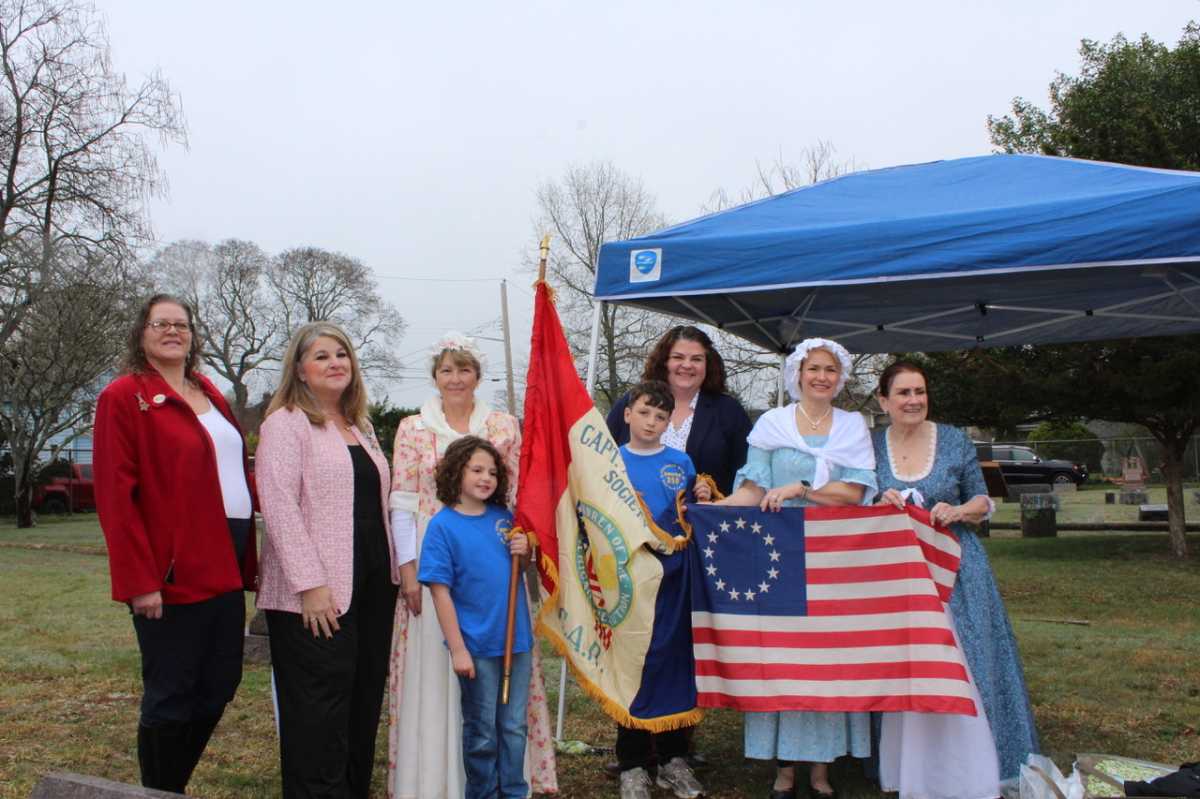
Revolutionary War Capt. Austin Roe, a Culper Spy Ring patriot, reportedly of modest demeanor, would likely have been surprised by the April 19 turnout at Cedar Grove Cemetery. The rededication of a marker in front of his gravestone (1749-1830), along with comments on his life as a significant risk-taker, drew 100 people, thanks mainly to the Greater Patchogue Historical Society (GPHS) and its treasurer, Steve Lucas, who hosted the event. But Children of the American Revolution (CAR) and Daughters of the American Revolution (DAR) are also part of the story.
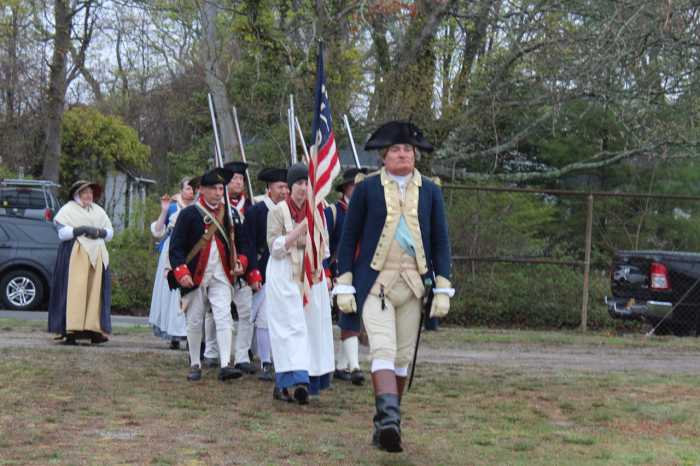
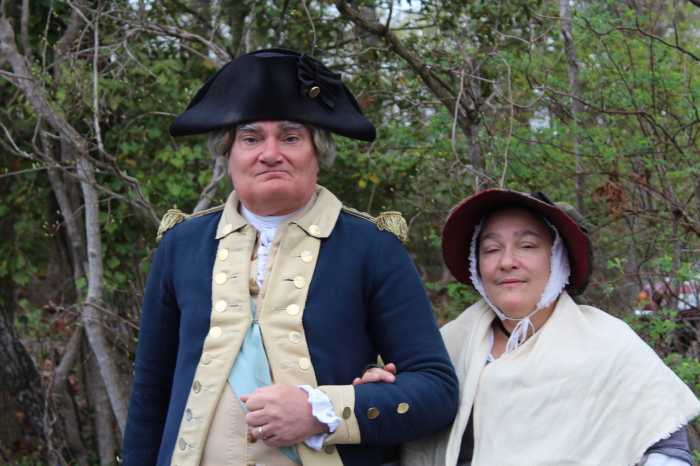
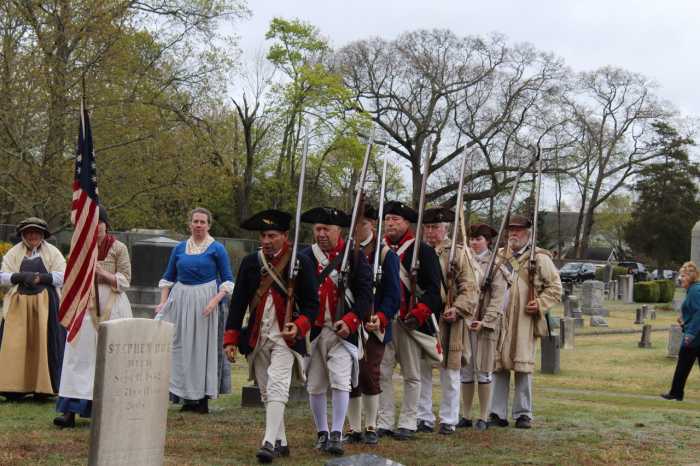
Third U.S. Infantry Regiment soldiers with muskets and a piccolo player marched alongside reenactors of George and Martha Washington. An 1861 Tarrott replica cannon was fired. State, county, and town officials, Brookhaven Town Historian Barbara Russell, Assemblyman Joe DeStefano, and Legislator Dominick Thorne were also present, along with 20 descendants of the Roe family—including John “Pete” J. Roe III, a Bellport Village judge for 40 years—Colonial Josiah Smith Chapter of DAR, Captain Roe Society of the CAR, and Sons of the American Revolution (SAR). The marker had an adventurous history that found its way back to the cemetery just a couple of weeks ago.
“We think the bronze marker was stolen about five years ago,” explained Lucas.
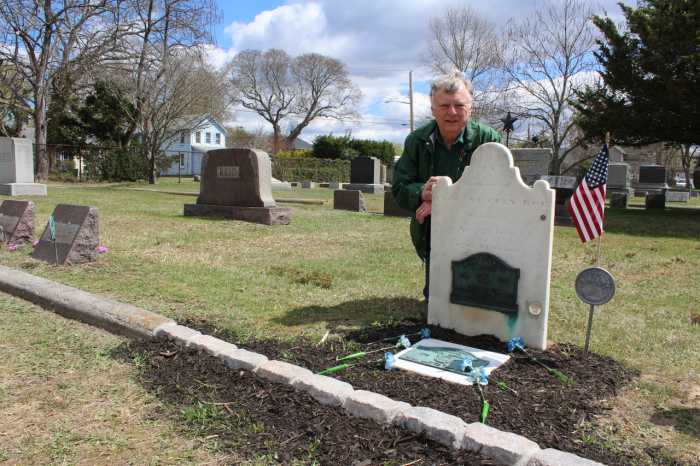
Captain Roe was a courier passing through British checkpoints, disguised as a carter of locally produced goods, relaying messages to George Washington, activities critical to the war’s success. Erin Shaw, president of the Captain Roe Society of the CAR, explained the marker’s eventual return.
“I was at a Tri-Hamlet 250th Anniversary meeting in Mastic when a gentleman there said he had found a marker. He had bought it at an antique sale and wanted to return it to one of the historical societies. We asked Laura about it.”
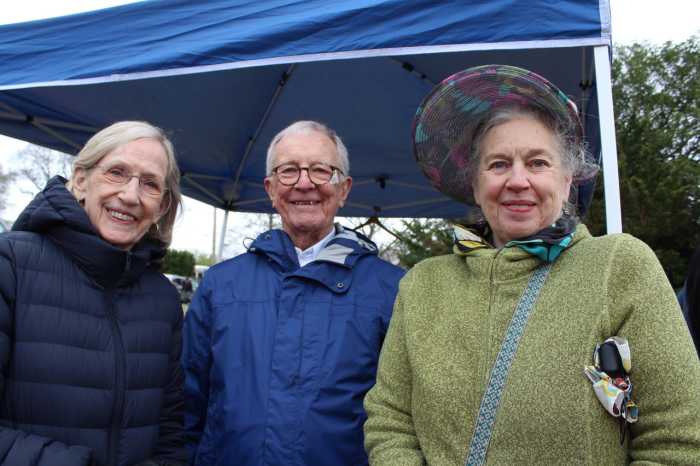
That would be Laura Miller, Regent of the Colonel Josiah Smith Chapter of the DAR, the parent organization whose inscription appears on the gravestone, who walked the cemetery to check. “We saw it wasn’t here,” Miller said. They got in touch with Lucas, who researched the history. An arrangement was made, and “[The owner] showed up at the (GPHS) museum with it; he’d found it in Center Moriches,” Lucas explained. “We’ve had it in our possession for about three years.”
The marker was set in a marble slab, thanks to Fricke Memorials, so it would stay put and was completed last fall. The years on the marker, 1775 to 1783, reflect the patriots’ time of duty, said Lucas. It’s not the first resting place for Capt. Roe, said Daniel Prunty, president of the not-for-profit Cedar Grove Cemetery and a volunteer. There were at least two others before his remains were reinterred at the current site.
“Everyone who built up Patchogue is buried here,” he explained. So that means many Roes are here, including Marjorie Roe, a beloved Patchogue property owner and philanthropist who passed away in 2020. She was a major supporter of the Friends of Patchogue-Medford Library; a reading room there was named in her honor. Contributions from the Roe family go on and on. In 1871, Justus Roe employed a cost-cutting technique using the tape measure. While not patented, Justus Roe and Sons popularized a more efficient tape measure design that marked off inches and feet intervals in their “Roe Electric Reel Tape Measures” during the late 19th and early 20th centuries. Besides the tape measure factory on Patchogue’s Main Street, there was a Roe hotel, a real estate business, and an insurance company. Mayor Paul Pontieri noted that Roe Avenue and Roe Boulevard, local streets, are named for the family.
Mark Sternberg, a Culper Spy Ring historian and non-fiction novelist of A Secret Service: The True Story of Washington’s Culper Spy Ring, said Capt. Roe wasn’t a tavern keeper but a working man. “He was a craftsman (specifically a joiner, a type of woodworker) who made windows, tables, chairs, even coffins,” he said. “Then came the war. He carted goods between New York City and Brookhaven, and beneath visible cargo in his wagon, he carried messages past the British. After the war, he resumed his life as a builder, helped furnish the local school, and settled in Pine Neck (now East Patchogue).”
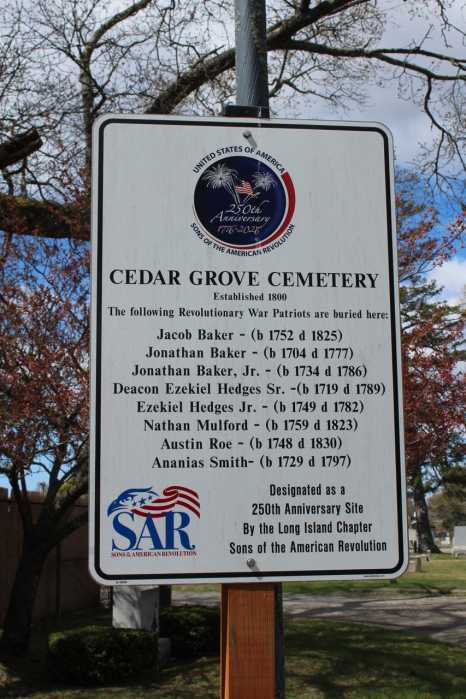
In his Journal of the American Revolution article, Culper Spy Austin Roe…the Joiner? Sternberg noted that Capt. Roe, “Most famously, he played a key role in disseminating the ring’s intelligence that the British were planning an assault on the French fleet at Newport, Rhode Island. In that instance, he managed the impressive feat of transporting the information 60 miles from New York City to Brookhaven in a single day by horseback. He was an essential link in the chain.” Capt. Roe was also a farmer and neighbor, Sternberg said in his speech. “His service was often quiet,” Sternberg emphasized.
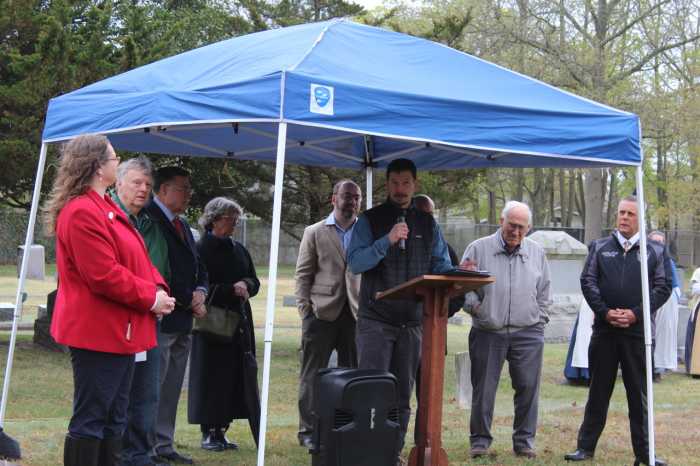
Daniel Roe, five times a great-grandson, traveled in from Maryland. He read, “The Midnight Rides of Austin Roe,” a poem by Paul Bailey. “Paul Revere rode one night,” he said, “Austin Roe did it several times.”
County Executive Ed Romaine thanked the DAR, CAR, as well as the Patchogue Historical Society and the Roe family. “It was 251 years ago today that the Battle of Lexington and Concord took place and the Midnight Ride of Paul Revere,” Romaine said. He mentioned the Constitution and its importance.
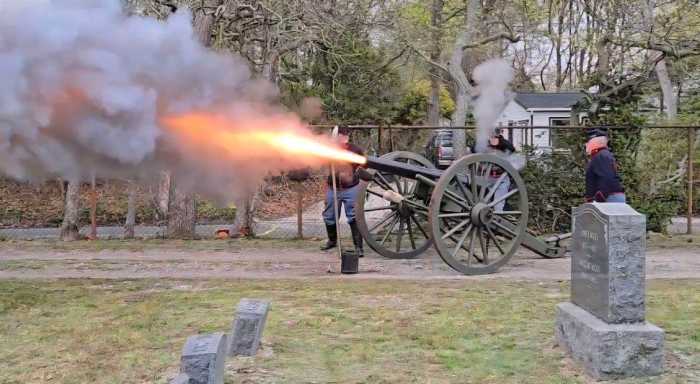
After the Third Regiment fired their muskets, the cannon boomed as a charcoal, sulfur, and saltpeter powder mix was discharged by Patchogue’s Deputy Mayor, Susan Brinkman, along with her husband, Paul, who are locally trained artillery personnel with the 6th Independent Battery, Light Artillery, New York State.
The Roe family traveled from Delaware, Virginia, Blue Point, Massachusetts, Brooklyn, and Nyack. Surprisingly, it was their first family reunion.
All photos by Linda Leuzzi, except where noted.