

The Town of Brookhaven has placed an 18-month moratorium on approving new data centers after public hearings that ran nearly six hours on the evening of July 16.
Residents were nearly unanimous in their support for the moratorium, citing the energy demands of these facilities, noise, and other impacts on nearby neighborhoods, as well as the morality of empowering artificial intelligence and technology giants. Town officials say the pause is needed to address strain on the electrical grid and the aquifer that supplies Long Island’s drinking water.
Brookhaven’s vote follows a statewide, year-long moratorium on new data centers that New York Governor Kathy Hochul approved earlier this week to study the same impacts. Town Supervisor Dan Panico said the added time reflects the size of the task, not a wish to slow-walk the issue.
“We are only six months more than that,” he said, describing a planning staff already stretched by an active caseload. “The task at hand before us is not a small one.”
WF Industrial—a developer also known as Wildflower behind a proposed data center in Yaphank valued at more than $1 billion—opposed the pause, arguing that the town already has a sufficient process for reviewing the scale and impact of new projects. Company representatives also said that once a tenant is selected, that company can pay to reduce or avoid the problems residents raised.
Town Attorney Annette Eaderesto testified that Brookhaven’s code does not currently define data centers as a use, leaving the moratorium as a placeholder while planners draft new rules. She said the studies ahead require coordination with the Long Island Power Authority, PSEG Long Island, and the Suffolk County Water Authority.
Councilman Jonathan Kornreich of Stony Brook was concerned about the strain on the electrical grid. “The project you’re talking about has the potential to capsize our electrical grid,” Kornreich said.
Panico also said that a senior member of PSEG told him that, on the horizon, they may have to bid for a peaker plant to offset the growing need for power on Long Island.
Matt DeCourcey, a consultant for Wildflower at Charles River Associates, offered a different interpretation of the grid data. He cited a 610-megawatt capacity margin on Long Island and said the system could support the project.
In addition, LIPA has said it does not anticipate any issues with serving the project’s proposed load and that any additional “transmission and substation infrastructure required to serve a large-load customer is paid for by the customer and does not impact LIPA ratepayers.”
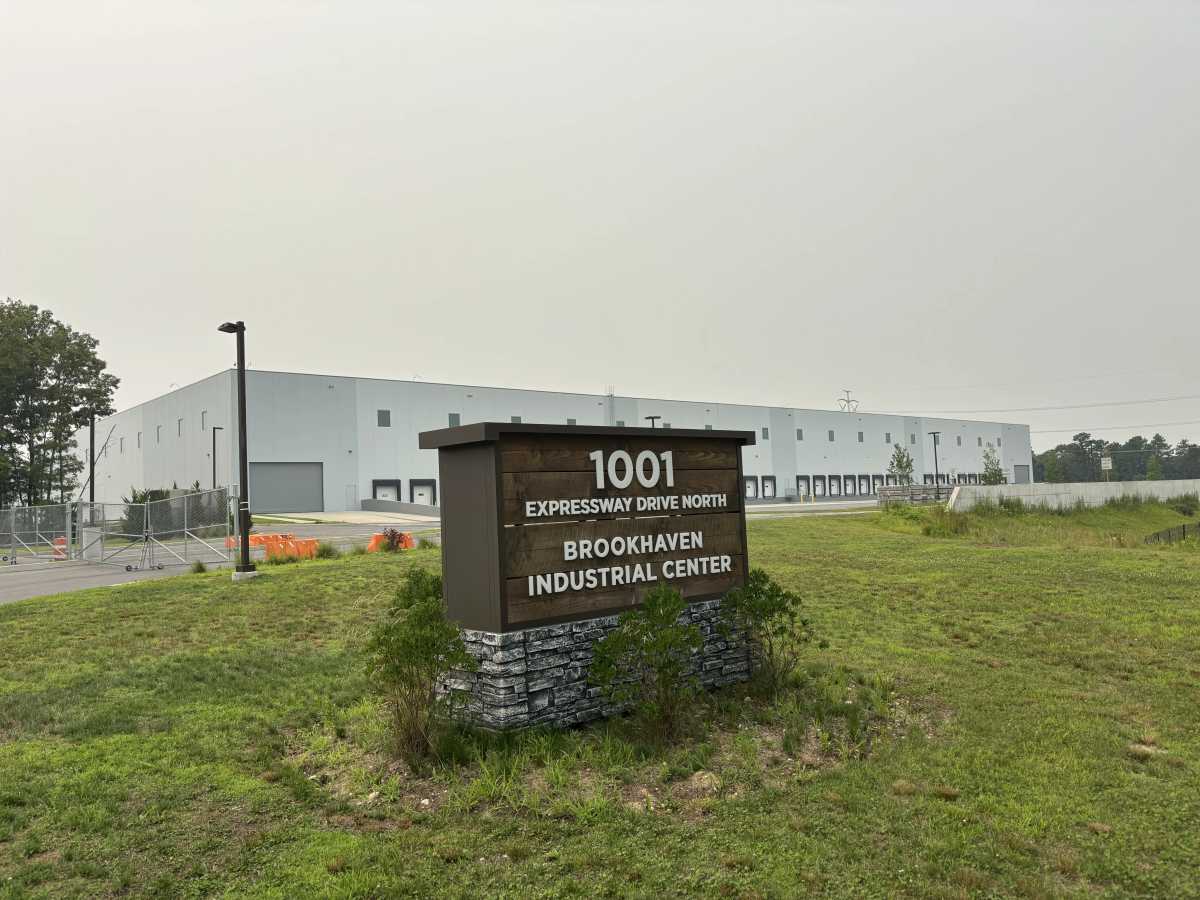
Wildflower representatives disputed the notion that every data center poses the same risk. Carrie O’Farrell, a senior partner at Nelson Pope Voorhis, said the Yaphank proposal would reuse an existing building.
“Not all data centers are the same,” O’Farrell said. “The buildings are already constructed. The infrastructure is there.”
The company said some modifications are required to convert the existing warehouses to house a large amount of technology. The project’s cooling system operates on a closed loop and requires a one-time fill of about 700,000 gallons, roughly the volume of an Olympic pool. After that fill, Wildflower said, the facility draws nothing further from the public water supply.
Wildflower and its labor allies said the moratorium threatens jobs and investment.
At the hearing, State Assemblyman Joseph DiStefano of Medford backed the town’s authority to make that call locally, arguing that land-use decisions belong to town officials rather than lawmakers in Albany. However, “such a policy does not promote economic growth,” DiStefano said. “It stands in its way.”
Michael Bowden, Wildflower’s director of development, said he understands what’s at stake.
“Quality of life, natural resources, everything that makes this place what it is, is incredibly important to me personally,” Bowden said. “The economic development that keeps our communities is also incredibly important.”
Wildflower representatives claimed the tax revenue was at stake. Annual property taxes on the site would climb from $1.8 million to $40 million, he said, with nearly $30 million a year going to the Longwood Central School District.
Monique Fitzgerald, climate justice and campaigns director for the Long Island Progressive Coalition, urged the board to move beyond a temporary pause. She wants the town’s separate land-use plan, which is being drafted, to bar data centers outright.
“Without a full ban on data centers in the Town of Brookhaven for the next 30 years,” Fitzgerald said, “then—that would be an injustice.”
Panico said Brookhaven cannot simply declare a ban by decree.
“You can’t just rule by fiat and edict and say, ‘From here on forward, there’ll be a ban,'” Panico said. “If you support a ban on these uses, it goes through the 18-month period of crafting a code.”
The moratorium gives Brookhaven’s Department of Planning, Environment and Land Management until early 2028 to draft zoning rules for data centers, a use not currently defined in the town code.
Two days earlier, the Town of Islip approved its own 18-month moratorium on July 14. Town Supervisor Angie Carpenter cast the sole vote against the hearing, citing concerns that the ban “doesn’t really comply with town code or New York State code.”
President Trump has said New York should reverse course and embrace data centers that accelerate artificial intelligence development.