


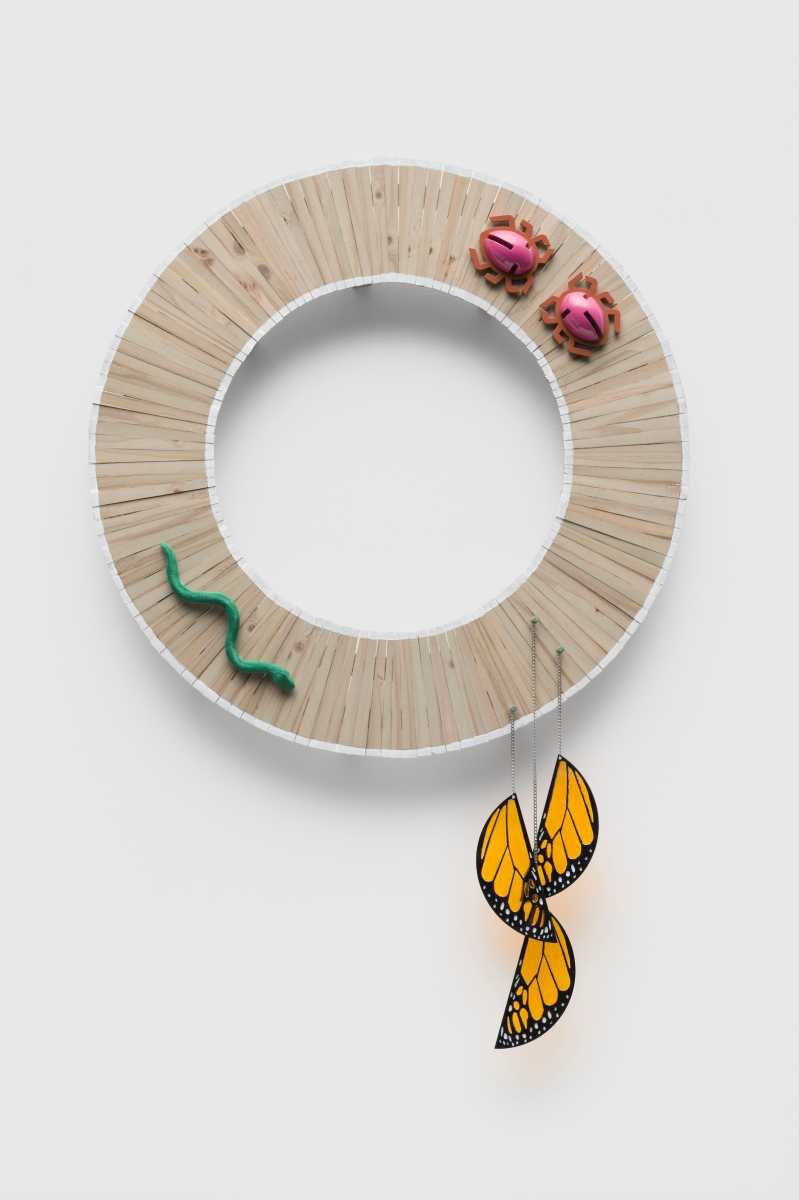
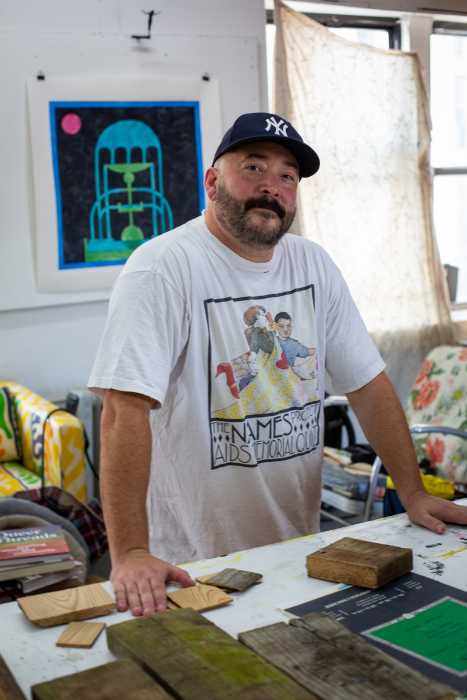
Chris Bogia is a New York-based artist and co-founder of the Fire Island Artist Residency. On Saturday, July 11, his exhibition, “Walks,” a sister show to “Fire Island Sun” at Mrs. Gallery, which was on view in June, opened at Carrington Cottage. The exhibition, curated by Jesse Firestone, brings together mixed-media works, fictional house signs, and photography to explore queer memory and the architectural and decorative traditions of Fire Island. Central to the show are Bogia’s Boardwalk Compositions: wall-mounted sculptures made from salvaged Cherry Grove boardwalk planks adorned with snakes, ticks, and butterfly wings, and reassembled to evoke the island’s winding pathways.
Fire Island News (FIN): When did you first come to Fire Island?
Chris Bogia (CB): It was probably around 2007. I had lived in the city for 11 years, and I had known about Fire Island, but only from gay magazines, and I was like, “I don’t know if this is my scene.” And invited there, we arrived in Cherry Grove at night. The next morning when I woke up, I was like, “‘What is this place? This is amazing.”
FIN: How did Walks come about?
CB: Last June, I started working on a show [Fire Island Sun] for the gallery that represents me in New York, Mrs. Early. Early in that development, I thought some of this work would make more sense on Fire Island. The fictional house signs in Walks, for instance: There’s a folk art tradition on Fire Island of naming houses and creating signs for them. But outside audiences wouldn’t know that.
Carrington Cottage (where Truman Capote and Harper Lee wrote their masterpiece) has only been up to code for about three years and hasn’t been used much. It seemed like the perfect place. To be one of the first artists to have a full-length solo show in the Meat Rack feels really special to me.
FIN: The first thing that struck me about the work is this element of childlike awe, and that’s beautiful in its own right, and definitely quite present, but it’s not all there is to it.
CB: My earliest relationship to art is seeing craft art kits done by my older sisters or my mom—embroidery kits from the ‘60s and ‘70s. That exposure was very formative, coupled with the fact that I’ve been an intense video game player since the early days—when things really looked quite minimal. That way of thinking really informed how I make things and what I would consider my aesthetic.
FIN: I always feel like I’m in Pac-Man when I’m walking around Fire Island. Your Boardwalk Compositions evoke that feeling perfectly.
Absolutely! That’s definitely what I was thinking about with those compositions: the way, in an early video game, for instance, you have three different digital images that all move around the board in the same way. And the monarch wings, snakes, and ticks: those are going to be the things that populate these boardwalks.
FIN: My primary association with butterflies and Fire Island is the monarch migration. Fire Island is where they stop to feed en route from Canada to Mexico in late summer and early fall. Is that where the butterfly wings on the Boardwalk Compositions came from?
CB: Exactly. In late summer, you see one butterfly, and then suddenly there’s six, and then you take three more steps, and there’s another six. It’s like a childhood fantasy come true! The butterfly wings in the compositions are actually made from shrink arts kits.
FIN: Tell me about the Prada-esque ticks that infest Walks.
CB: In 1996, I moved to New York to go to NYU and got a job at Armani Exchange, which was on Prince and Broadway. Across the street was the New Museum, but then Prada took it over, and it’s still there today. It’s their flagship store in the U.S. By 1999, I was still working down there, but for the designer Todd Oldham. Prada did this collection where the clothes were highly embellished with suede autumnal leaves and then these beetles. They were flat, patent leather versions of what you see in the sculptures in Walks. I originally recreated those using the same techniques used to put them on the boardwalks, but they were a little flat. So, I decided to render them in 3D, print them in resin, and then lacquer them.
FIN: How much of this work was made on Fire Island versus in your studio in the city?
CB: I have a full woodshop at my studio in the Bronx, so that’s where most of the labor happens. But all of this work was sketched out on the island last summer.
FIN: Is FIAR interwoven with your practice, or do you see them as separate aspects of your work?
CB: In 2011, my curator friend Evan Garza, my partner Rod Sayegh (who’s now my husband), and I decided to start FIAR. It was really at Evan’s insistence; I don’t know that I would have done it on my own. It was a labor of love. That’s when I realized the residency was a piece of social practice work. When that happened, my work shifted: before, I’d felt it needed many queer and perhaps erotic signifiers, but recognizing the residency as part of my work lifted that pressure.
“Walks” remains on display at Carrington Cottage through August 9.
Gallery Hours: Thursday–Sunday, 11a.m–6 p.m., or by appointment with advance notice by emailing visitwalks@gmail.com.