

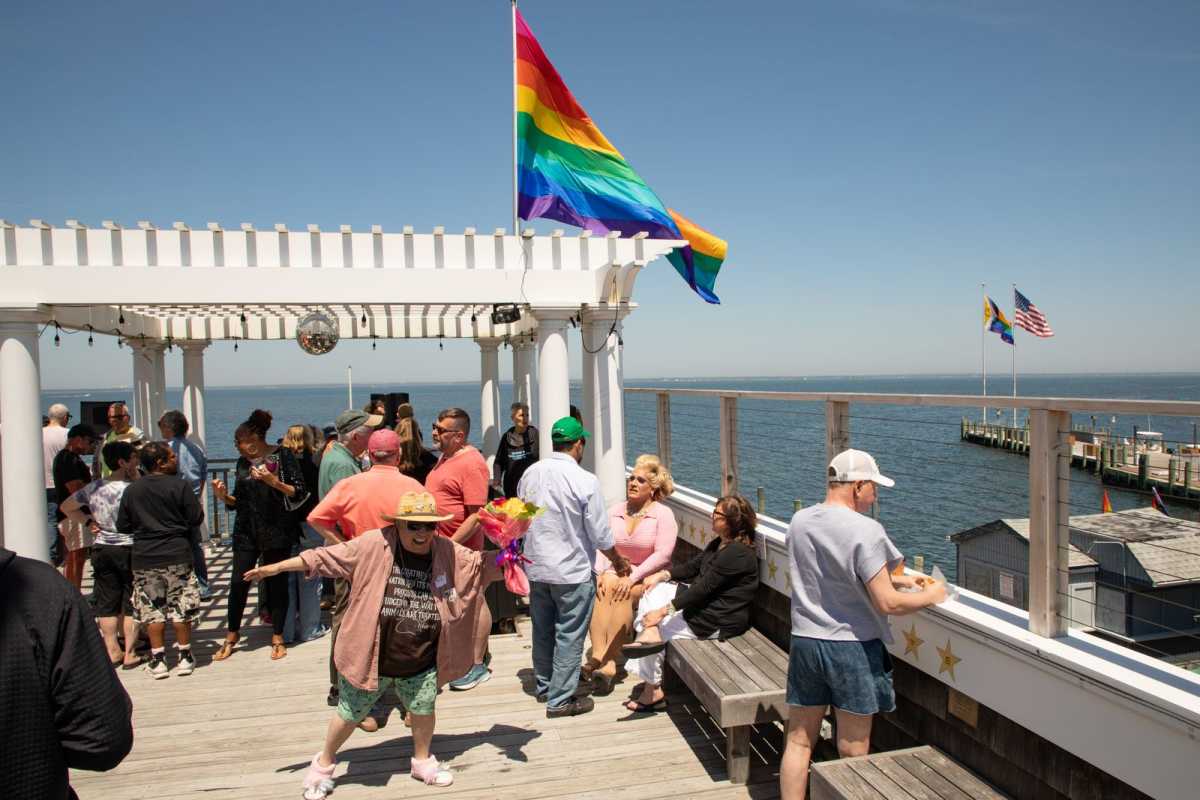
The Cherry Grove community gathered at the historic Community House & Theater to unveil and dedicate a new 60-foot Pride flag mast overlooking the Grove at the first meeting of the 2026 season for the Cherry Grove Community Association Inc. (CGCAI) on May 17.
Rising above the rooftop facing the Great South Bay—where Cherry Grove’s famous community tea dances are often held—the mast now stands prominently above one of the community’s most historic gathering places.
The mast, generously donated by Mike Fisher and Gary Sacks, was installed to permanently fly and rotate large queer pride flags throughout the summer. The rotating flags will include the Intersex Pride Flag, the Transgender Pride Flag, and the Gilbert Baker Pride Flag, honoring former Cherry Grove resident and LGBTQIA+ icon Gilbert Baker, creator of the original Rainbow Pride Flag.
“Gilbert Baker called Cherry Grove home, and it was right here, on our very own dock, that he first hoisted the rainbow Pride flag and gave the world one of its most enduring symbols of belonging,” CGCAI President Amy Schreiber said. “The flag was never meant to be political. It was designed as a symbol of [the] … people. Gilbert’s original 1978 flag flew eight colors, each carrying meaning: hot pink for sex, red for life, orange for healing, yellow for sunlight, green for nature, turquoise for magic and art, indigo for serenity, and violet for spirit. Not political colors. Human ones.”
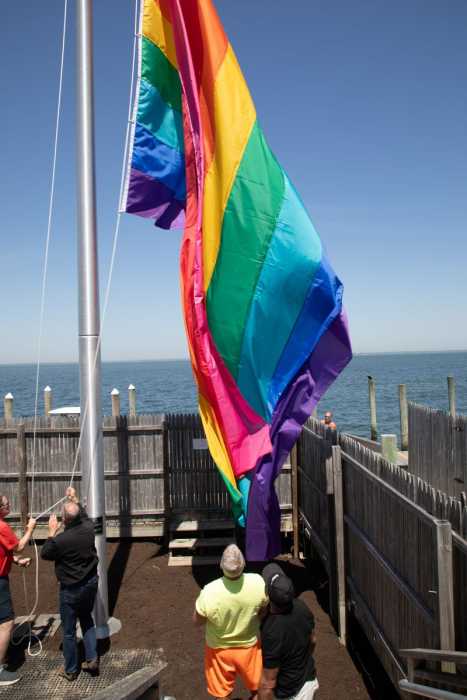
Following the meeting, community members gathered on the rooftop for the official Pride flag-raising ceremony led by Panzi, Porsche, and Schreiber.
Addressing attendees before the flag raising, Schreiber reflected on Cherry Grove’s long history as a refuge and creative sanctuary for LGBTQIA+ people.
Schreiber spoke about the generations of queer people and allies who helped protect and sustain the Grove during times when queer life was criminalized and marginalized elsewhere. She acknowledged early community families and supporters, including the Minnells, the Fallons, the Skinners, the Gerrodettes and others who helped lay the foundation for Cherry Grove as a place of acceptance and belonging.
“This community exists because of courage,” she said. “Years ago, when being queer was a crime, there were people who chose compassion over fear, who wrapped their arms around this place and helped protect us.”
Particular attention was given to the historic significance of the Cherry Grove Community House itself, home to the nation’s oldest LGBTQIA+ summer theater and listed on the National Register of Historic Places.
“Just imagine what this building meant when there was nowhere else to go,” Schreiber added. “When this was the only place to harness queer expression. It is sacred ground, and we will treat it that way.”
Mike Fisher and Gary Sacks, along with Craig and Steve Williams, helped raise a new 15-by-25-foot Gilbert Baker Pride flag during the ceremony. Cherry Grove legends Panzi of the Invasion of the Pines and Porsche joined a large crowd gathered on the Community House rooftop to sing “I Am What I Am” while watching the satiny rainbow colors soar into the sunlight above the Great South Bay.
Joy and tears were shared as the community reflected on the continuing care and preservation of Cherry Grove, a sanctuary and beacon for the LGBTQIA+ community that has welcomed generations to its home.
The newly installed mast now stands as a permanent visual marker of that legacy, carrying Pride flags above one of the nation’s most historically significant queer cultural sites.